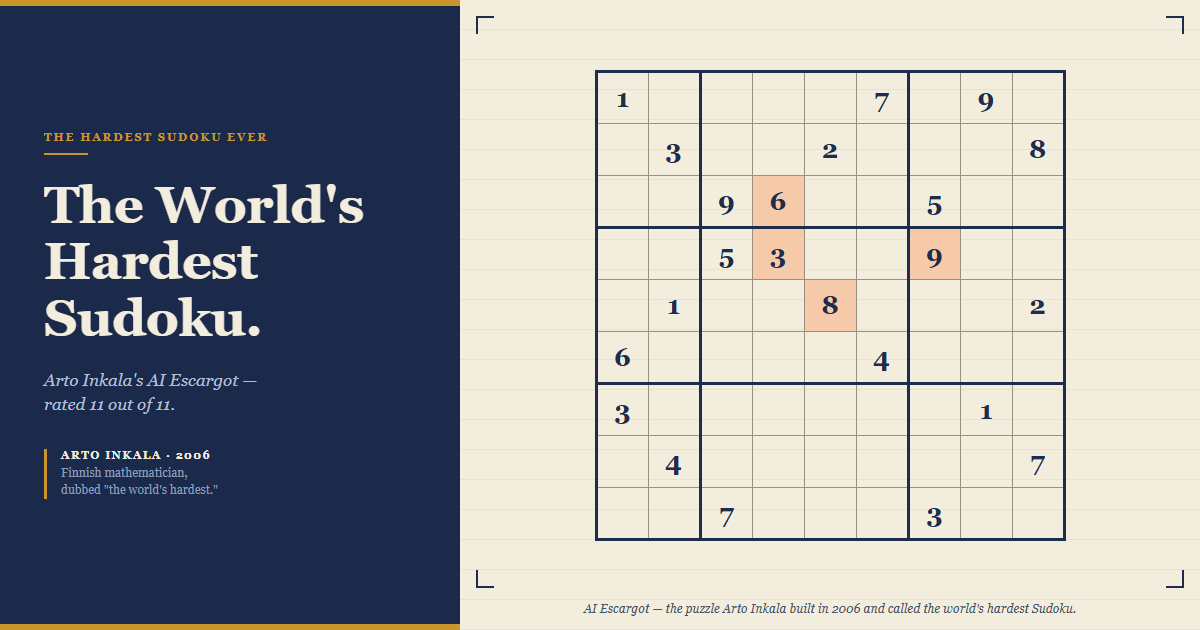
What is the Hardest Sudoku Puzzle Ever Made?
What is the hardest Sudoku ever made? Meet AI Escargot by Arto Inkala, why it scores 11 of 11, and how the world’s toughest puzzles are really measured.
Sudoku is a logic puzzle with simple rules — but mastering it takes focus and practice. Here's everything you need to know.
Free, no sign-up
Prefer to learn by doing? Start solving now — the rules are below.

Sudoku is a logic puzzle played on a 9×9 grid divided into nine 3×3 boxes. The goal is straightforward: fill every empty cell with a number from 1 to 9, so that each row, each column, and each 3×3 box contains every number from 1 to 9 exactly once. No number can repeat within the same row, column, or box. No mathematics is involved — only logic and deduction. Every sudoku puzzle begins with some numbers already placed in the grid. These pre-filled numbers are called givens or clues. As a rule of thumb, the more givens a puzzle has, the easier it is to solve. An easy puzzle might start with about 36 to 45 numbers already placed; an expert puzzle with only 19 to 21, leaving the majority of the grid for you to work out. The three rules of sudoku are simple. First: each row must contain the numbers 1 through 9, each appearing exactly once. Second: each column must contain the numbers 1 through 9, each appearing exactly once. Third: each of the nine 3×3 boxes must contain the numbers 1 through 9, each appearing exactly once. Every deduction you make follows from these three constraints.
There's really just one rule, in three parts: every row, every column, and every 3×3 box must hold the digits 1 to 9 once each — no repeats. That's the whole game. For the full breakdown, the variants, and what is not a rule, see the complete sudoku rulebook.
To get started, look for the easiest placements first. Find a row, column, or box that is nearly complete — if eight of the nine cells are already filled, the missing number is obvious. Work through all of these easy wins before attempting anything more complex. This approach gets more numbers on the board quickly and creates new deductions to work with. As you fill in more cells, you will start to see which numbers can possibly go in each remaining empty cell. When a cell has only one possible number given what is already in its row, column, and box, fill it in. This is the most fundamental sudoku technique and handles most easy puzzles on its own. Once you move beyond easy difficulty, you will need to think more carefully. Writing small candidate numbers in each empty cell — known as pencil marks or notes — helps you track possibilities and spot patterns that are impossible to see otherwise. From there, techniques like hidden singles, pointing pairs, and naked pairs let you eliminate candidates and make progress even when no single cell has an obvious answer. The guides in this section cover everything from the absolute basics to the rules, history, and benefits of sudoku. If you are completely new, start with the rules guide. If you have played before but want to get better, explore the strategy guides linked here and on our strategies page.
Here's the order to work in on your very first puzzle. Follow these four steps and most easy grids fall into place.
Scan the grid for a row, column, or 3×3 box that already has most of its cells filled. If eight of the nine are in place, the last digit is the only one missing — drop it straight in.
Work through the whole board placing each cell that can only hold one digit, given what's already in its row, column, and box. Clear all of these easy wins first — each one opens up the next.
When the easy placements run out, write small candidate numbers (pencil marks, or notes) in every empty cell. Seeing the possibilities laid out is how you spot patterns you'd otherwise miss.
Now hunt for a digit that fits only one cell in a row, column, or box — a hidden single — and for pairs that let you rule candidates out. These deductions carry you through harder puzzles to the finish.
A "naked single" is a cell where only one digit is possible. Check each empty cell against its row, column, and box to find these.
For harder puzzles, use the notes feature to mark all candidates for each cell. This lets you spot patterns without guessing.
A "hidden single" is a digit that can only go in one spot within a row, column, or box — even if that cell could hold other digits.
Every Sudoku puzzle has exactly one solution reachable by pure logic. If you find yourself guessing, back up and look again.
Every solve awards XP — more for harder difficulties. Hit 500 XP to level up. Harder puzzles earn more, so mix up the difficulty to climb faster.
Solve at least one puzzle per day and your streak grows. Skip a day and it resets to 1. The flame icon next to your avatar shows your current streak.
Add friends by email, then challenge them to race on the exact same puzzle. Winner earns a bonus on top of the solve reward. Add friends via the Add a Friend page.
Two tabs — All-Time ranks everyone by total XP, Last 7 Days rolls forward every minute. Your row is highlighted when you're on the page.
Sudoku has exactly three rules. Each row must contain the digits 1 through 9, each appearing once. Each column must contain the digits 1 through 9, each appearing once. And each of the nine 3×3 boxes must contain the digits 1 through 9, each appearing once. Every deduction in a sudoku puzzle follows from these three constraints — no arithmetic is involved.
No. Every puzzle on sudoku247online.com is free to play as a guest with no sign-up, no email, and no credit card. Creating a free account unlocks XP, levels, a daily streak, the global leaderboard, friend challenges, and an ad-free experience — but it is entirely optional and never gates puzzle access.
The technique each one forces you to use. Easy grids fall to plain scanning — find the one cell in a row, column, or box where a digit can still go. Medium adds pencil marks and pairs: you write the candidates down and start ruling them out. Hard leans on pointing pairs and locked candidates, where a digit trapped in part of a box clears it from a whole row or column. Expert forces the advanced patterns — X-Wing, Swordfish, XY-Wing chains — on nearly every grid. Each step up does hand you fewer starting numbers (easy about 36–45, expert about 19–21), but the count is a symptom of the difficulty rather than the cause. Expert also rewards more XP per solve.
Start by scanning for "naked singles" — cells where only one digit is possible given what is already in their row, column, and box. Once you exhaust those, switch on pencil marks (notes mode) and write candidates in each empty cell so you can spot hidden singles, pointing pairs, and naked pairs without losing your place. The strategies guide on Sudoku247Online covers each technique in detail.
Yes. The print hub at /print generates unlimited free printable sheets — 1, 4, or 6 puzzles per page, any difficulty, in 9×9 Classic, 6×6 Mini, or 4×4 Kids grids. Sheets are watermark-free, optimised for minimal ink, and require no sign-up or email. The "Print Today's Puzzle" button on the homepage links straight to the most-printed configuration.
The rules above govern Classic 9×9 Sudoku — what most people mean by "sudoku". Sudoku247Online also ships several variants on the same engine:
Cages with target sums replace givens. Every digit in a cage must be distinct AND add up to the cage total — sudoku.com's #2 mode.
A faster, friendlier grid using digits 1-6 in 2×3 boxes. Great for breaks, beginners, or younger solvers.
The smallest grid — digits 1-4 in 2×2 boxes. The gentlest entry into logical deduction for young children.
Two new difficulty tiers above Expert on the standard 9×9 grid. Minimum givens, advanced technique territory.
Once the rules feel automatic, technique guides are how you climb. Each technique below has its own deep-dive page with a worked example — start with the beginners.
Once pencil marks become second nature, tidy them up with Snyder notation — a faster way to mark only the candidates that actually matter.
Beginner — a cell with only one possible digit. The most common move in sudoku.
Beginner — a digit with only one possible cell within a row, column, or box.
Intermediate — two cells sharing the same two candidates lock those digits in.
Advanced — a 2×2 pattern that prunes a digit across two columns or rows.
Want the deeper theory behind each rule? Start with sudoku basics on Sudoku247Wiki — the plain-English reference for the whole game.
What is the hardest Sudoku ever made? Meet AI Escargot by Arto Inkala, why it scores 11 of 11, and how the world’s toughest puzzles are really measured.
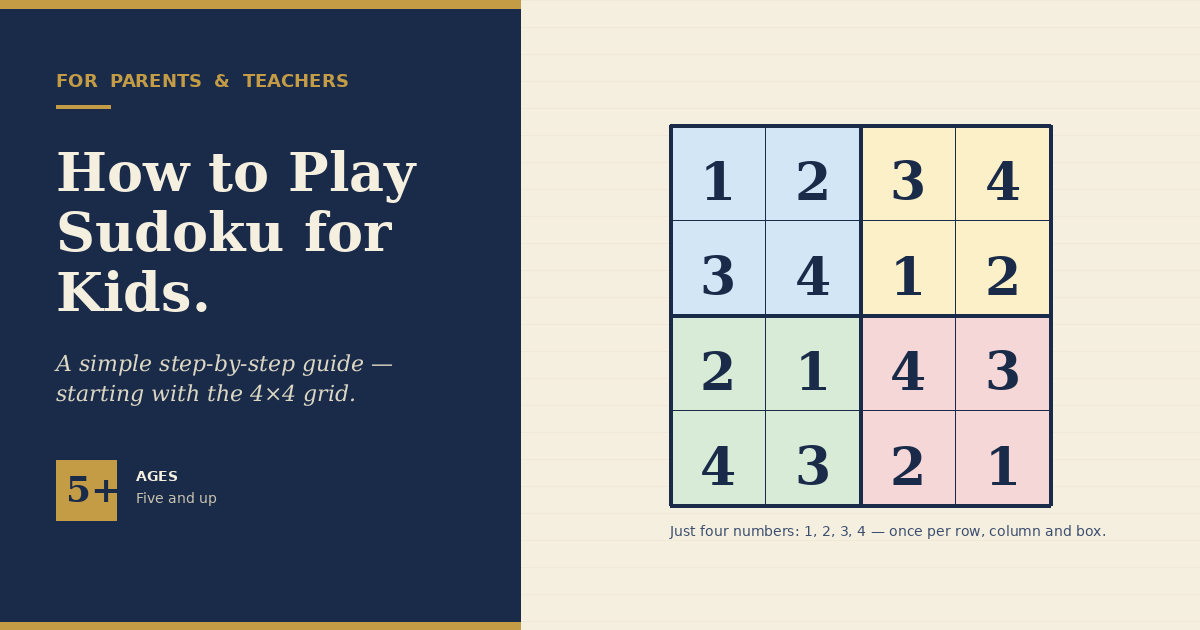
Sudoku is one of the best logic games for children. It teaches systematic thinking, builds concentration, and gives kids the satisfaction of solving a real puzzle through their own reasoning. And because it uses numbers purely as symbols — no maths involved — children as young as five or six can learn to play. This… Continue reading on How to Play Sudoku for Kids: Simple Step by Step Guide
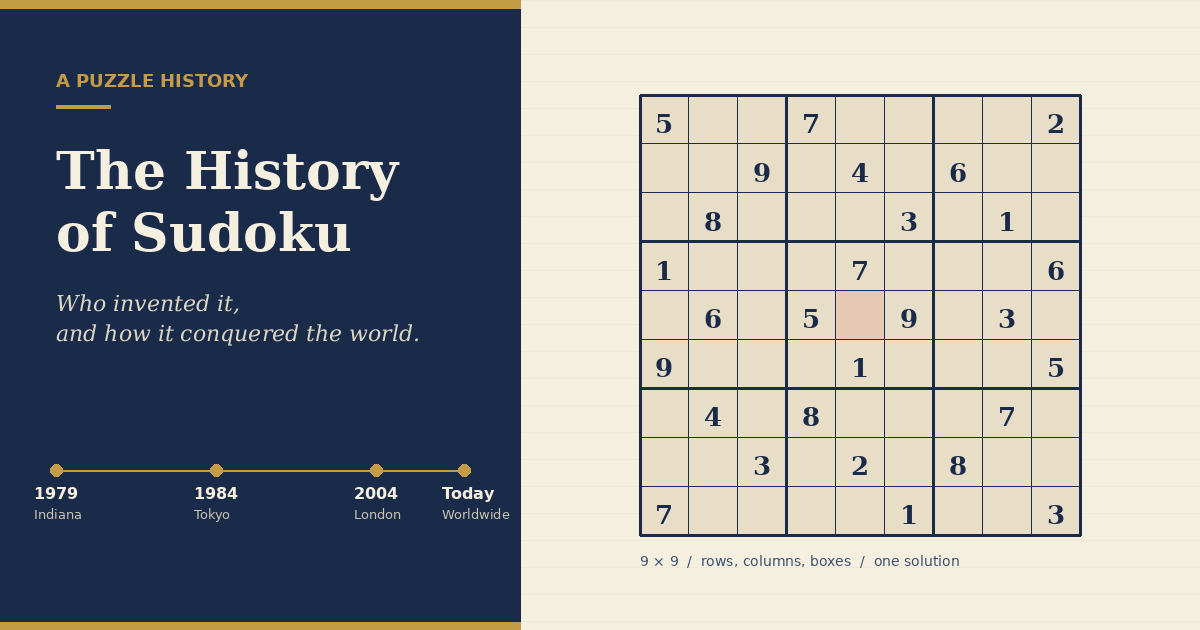
Sudoku is one of the most widely played puzzles in the world — published daily in thousands of newspapers, solved by millions of people on phones and tablets, and the subject of international championships. Yet most people who play it every day have no idea where it came from, who invented it, or why it… Continue reading on The Untold Sudoku History: From Indiana to the World