Sudoku Strategies & Techniques
Beginner to advanced — every technique with a worked example.
Prefer the reference-book version? Browse the complete technique encyclopedia on Sudoku247Wiki — every pattern explained from scratch.
Working with pencil marks? Learn how candidate mode tracks every number a cell can still take, then tighten your notes with Snyder notation.
Beginner
Start here — single-cell deductions you'll use in every puzzle.
Intermediate
Pair- and triple-based reductions for Medium and Hard tiers.
Locked Candidates
When a digit's candidates inside one unit fall entirely within another unit.
Pointing Pair & Triple
A digit confined to one row or column inside a box.
Claiming Pair & Triple — Box-Line Reduction
A digit confined to one box inside a row or column.
Box-Line Reduction
A row or column confines a digit into a single box — clear the rest of the box.
Naked Pair
Two cells holding the same two digits — locks them out elsewhere.
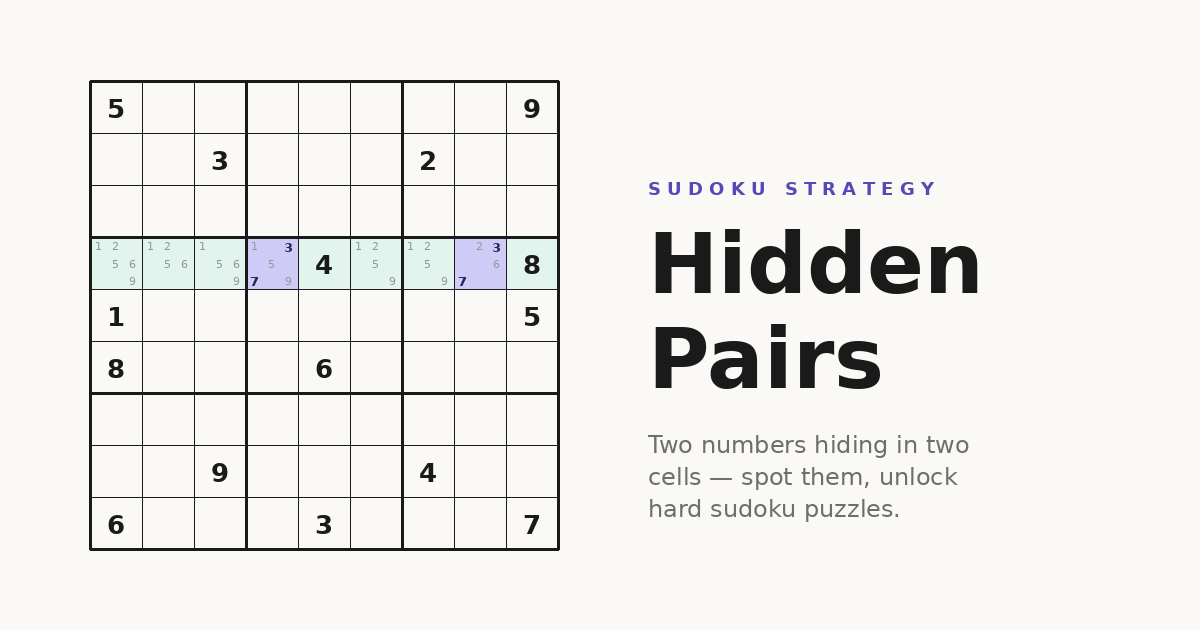
Hidden Pairs in Sudoku — How to Spot and Use Them
Hidden pairs is one of those techniques that feels like magic the first time you use it. Two candidates are hiding in plain sight, locked into just two cells — and once you see them, you can eliminate everything else from those cells and often unlock a chain of progress. This guide explains what hidden… Continue reading on Hidden Pairs in Sudoku — How to Spot and Use Them
Naked Triple
Three cells holding three digits between them.
Hidden Triple
Three digits hidden in exactly three cells, hidden behind extra candidates.
Naked Quad
Four cells whose combined candidates contain exactly four digits.
Hidden Quad
Four digits hidden in exactly four cells behind extra candidates.
Advanced
Pattern-based techniques for Expert and beyond.
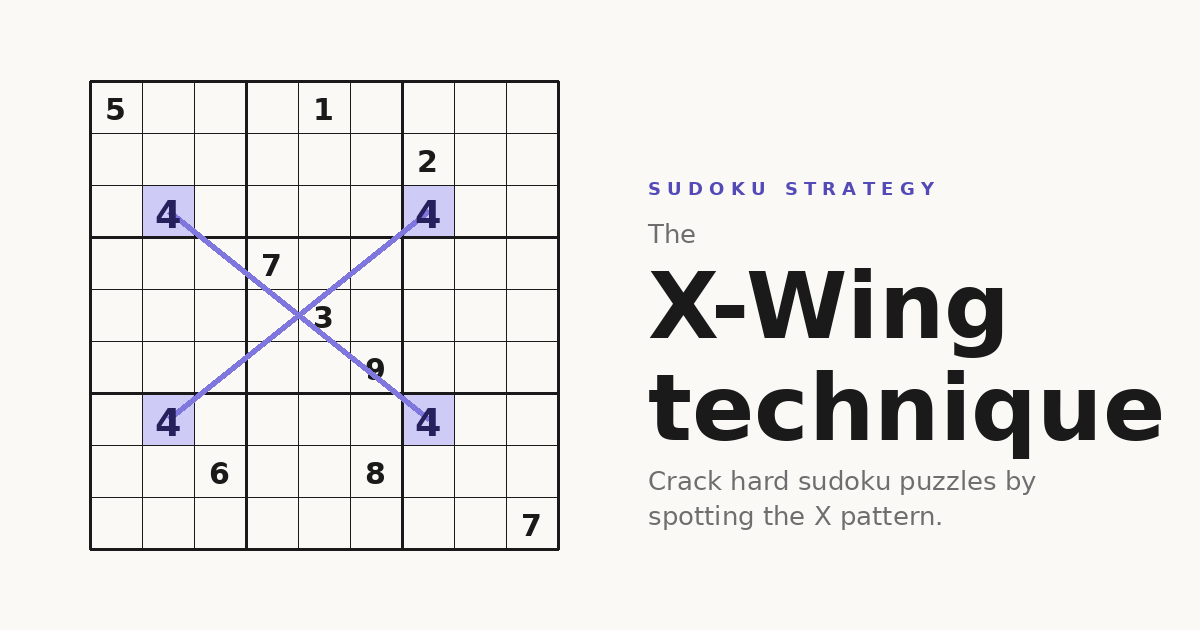
X-Wing Sudoku Strategy: How to Spot and Use It
If you have worked through easy and medium puzzles without much trouble but keep hitting a wall on hard difficulty, the X-Wing technique is probably the missing piece. It sounds intimidating but the logic behind it is clean and satisfying once you see it. This guide explains exactly what X-Wing is, when to use it,… Continue reading on X-Wing Sudoku Strategy: How to Spot and Use It
Swordfish
Three rows or columns locking a digit into a 3×3 grid pattern.
Jellyfish
Four rows or columns locking a digit into a 4×4 grid pattern.
Finned X-Wing
An X-Wing with one extra 'fin' cell — eliminations shrink to the fin's neighbourhood.
XY-Wing
A pivot {X,Y} cell with {X,Z}/{Y,Z} pincers forces Z out of common neighbours.
XYZ-Wing
A trivalue {X,Y,Z} pivot with two bivalue pincers — sees-all-three loses Z.
W-Wing
Two identical {X,Y} bivalue cells linked by a strong Y link force X elsewhere.
Skyscraper
Two row strong links sharing a column — the tops force an elimination.
2-String Kite
A row strong link + column strong link sharing a box force an elimination.
Empty Rectangle
A box with a digit confined to one line, plus a strong link, forces an elimination.
Simple Coloring
Color a digit's strong-link chain; cells seeing both colors lose the digit.
Multi-Coloring (3D Medusa)
Run Simple Coloring on every digit at once for cross-digit eliminations.
Remote Pairs
A chain of bivalue {X,Y} cells whose endpoints hold opposite digits.
Unique Rectangle
Four cells in a deadly {X,Y} rectangle must break the two-solution pattern.
BUG +1 (Bivalue Universal Grave)
Every empty cell bivalue except one — the outlier's third candidate is the answer.
Killer Sudoku-specific
Cage-aware techniques unique to the Killer variant — built on the 45 rule.
45 Rule — Killer Sudoku Technique
Every row, column, and box sums to 45 — subtract cage sums to find the missing cell.
Innies and Outies — Killer Sudoku Technique
Cells crossing a unit boundary carry known partial sums — pin them with the 45 rule.
Cage Combinations Cheat Sheet — Killer Sudoku Technique
Every (size, sum) cage has a fixed list of legal digit sets — rule out the rest.
Cage Splitting — Killer Sudoku Technique
Split a crossing cage by unit; each sub-region's sum is bounded by the 45 rule.
Which techniques you'll need at each difficulty
Sudoku tiers map to a roughly fixed technique ladder. Each tier extends the previous one — Medium needs everything Easy needed plus more, and so on.
- Easy →Naked single + hidden single. Pure scanning is enough.
- Medium →Add pointing pair, claiming pair, and naked pair.
- Hard →Add hidden pair and naked triple.
- Expert →Add X-Wing and the rest of the advanced cluster.
- Master →All of the above with the longest deduction chains.
- Evil →Every known technique can be required somewhere in the puzzle.
Try a technique on a real puzzle
Open the step-by-step solver — every move names the technique used.