How to Play Sudoku for Kids: Simple Step by Step Guide
Sudoku is one of the best logic games for children. It teaches systematic thinking, builds concentration, and gives kids the satisfaction of solving a real puzzle through their own reasoning. And because it uses numbers purely as symbols — no maths involved — children as young as five or six can learn to play. This guide explains how to teach sudoku to kids, starting with the smallest grid and working up.
Why Sudoku Is Great for Kids
Before diving into the rules, it is worth understanding why sudoku is worth introducing to children in the first place.
Sudoku builds logical thinking — the ability to reason through a problem step by step, eliminating wrong answers to find the right one. This skill transfers directly to maths, science, and problem-solving in everyday life.
It develops concentration — the ability to focus on one task without distraction. A sudoku puzzle requires sustained attention that gets longer and more demanding as the grid gets bigger. Regular practice builds this capacity naturally.
It teaches systematic approach — working through possibilities methodically rather than guessing randomly. Children who learn to solve sudoku learn to approach problems in an organised way.
And it is genuinely fun. The moment a child finishes their first puzzle through their own reasoning is a real milestone — a small but concrete experience of solving something hard.
Start with 4×4 Sudoku
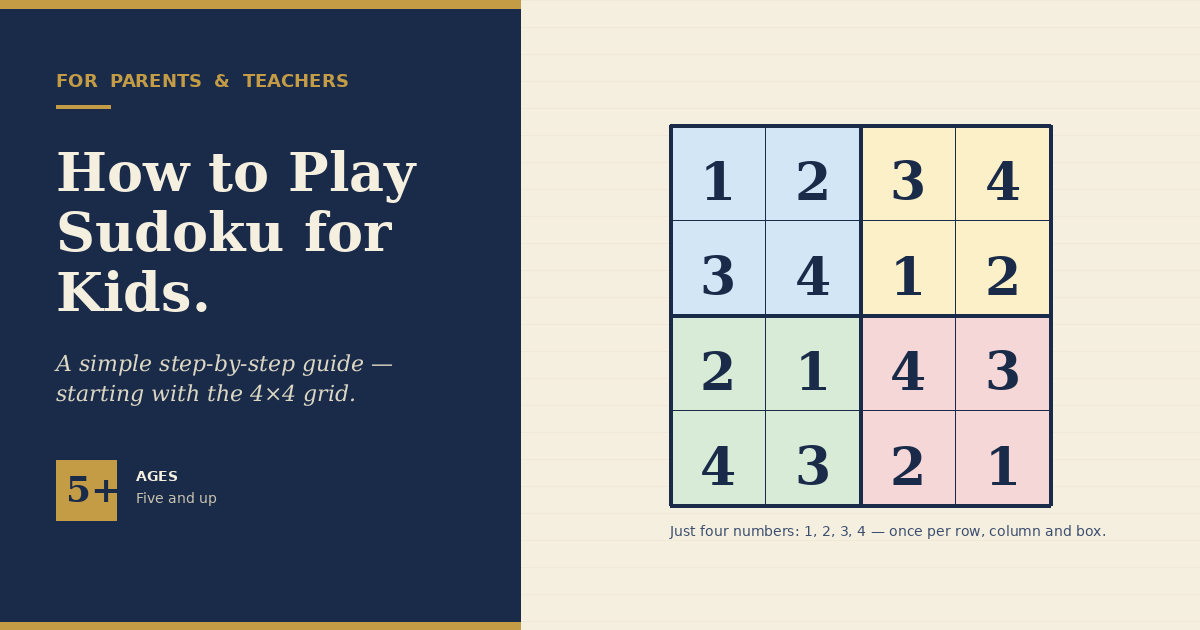
Do not start children on the full 9×9 grid. It is too large and the rules can feel overwhelming. Start with the 4×4 grid, which uses only the numbers 1 through 4 and has four 2×2 boxes instead of nine 3×3 boxes.
The rules are identical to standard sudoku but much simpler to grasp:
- The grid is 4 cells wide and 4 cells tall
- It is divided into four 2×2 boxes
- Use only the numbers 1, 2, 3, and 4
- Each row must contain 1, 2, 3, and 4 exactly once
- Each column must contain 1, 2, 3, and 4 exactly once
- Each 2×2 box must contain 1, 2, 3, and 4 exactly once
A typical 4×4 puzzle has 6 to 8 numbers already filled in. A child who understands the three rules can usually complete it in 2 to 5 minutes.
Explaining the Rules to a Child
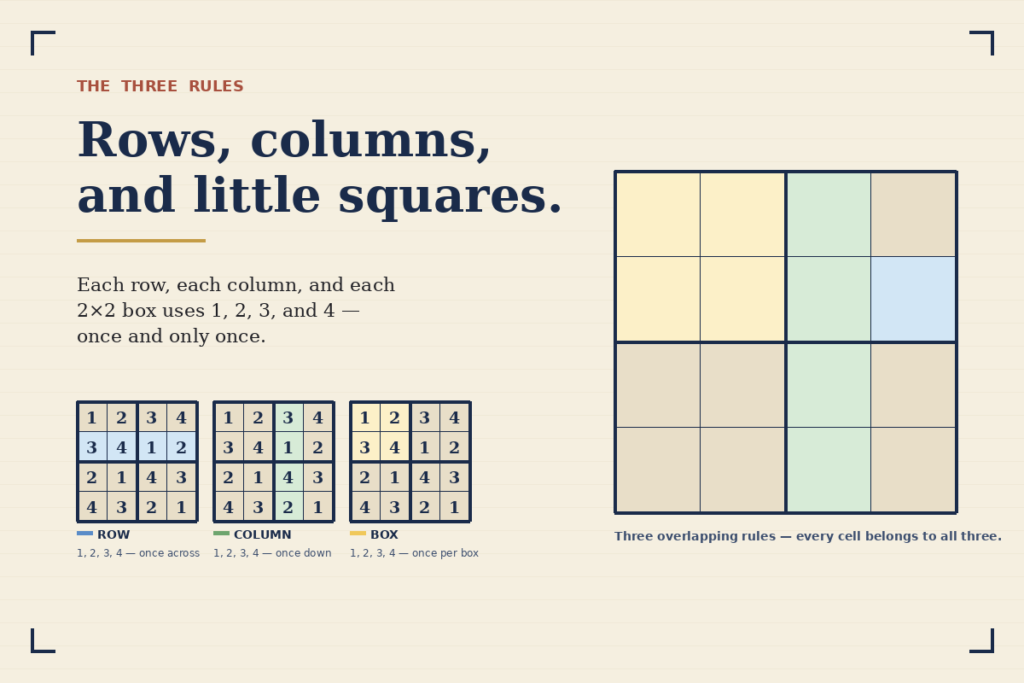
Use simple language and a visual example. Show a 4×4 grid and explain it like this:
“Look at this grid. It has 4 rows going across, 4 columns going down, and 4 small squares in the corners. We need to put the numbers 1, 2, 3, and 4 in every empty box. But here is the tricky part: each number can only appear once in every row, once in every column, and once in every small square.”
Point to a row and count — “See, this row already has 2 and 4. So we need to put 1 and 3 somewhere in this row. We just need to figure out which goes where.”
Show them how to find a cell where only one number fits. “This empty cell is in a row that has 1, 3, and 4. And it is in a column that has 2. So the only number left is… what?” Let them answer. That first deduction — finding the answer themselves — is the moment they start to get it.
The First Technique: Elimination
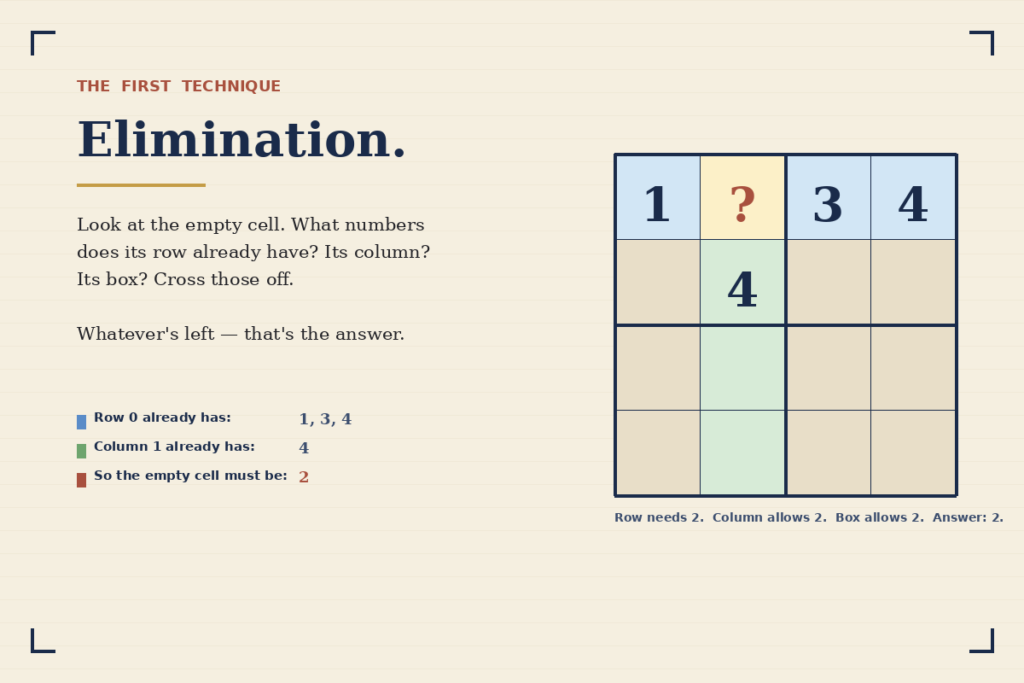
The most basic sudoku technique is elimination, and it is easy for children to understand.
For any empty cell, look at what numbers are already in its row, column, and box. Any number already present cannot go in that cell. If only one number is missing, that is the answer.
Teach children to say the process out loud: “This row has 1, 2, and 4. This column has 3. So this cell must be… I need to find a number that is not 1, 2, 3, or 4… but wait, those are all of them. Let me check again.” Working through it verbally helps children internalise the logic.
Moving Up to 6×6 Sudoku
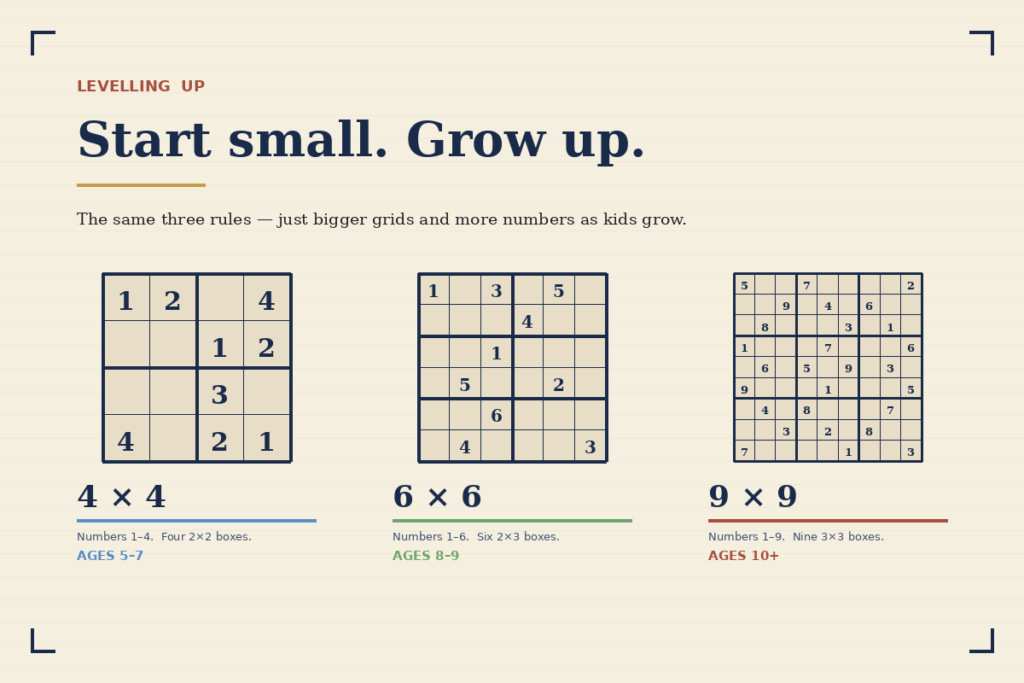
Once a child can solve 4×4 puzzles comfortably — completing them without help in under 3 minutes — they are ready to try 6×6.
The 6×6 grid uses numbers 1 through 6 and has six 2×3 boxes. The rules are identical. The step up in difficulty is noticeable but manageable for children who have mastered 4×4.
Play a free 4×4 sudoku for kids on this site — puzzles are generated fresh every time and sized for children with a clear, easy-to-read grid. When they are ready for a bigger challenge, mini sudoku 6×6 is the natural next step.
Tips for Teaching Sudoku to Kids
Be patient with the first puzzle. The first time through, walk alongside them. Let them make the deductions but be ready to guide them back on track if they get confused.
Let them make mistakes. If a child places a wrong number, do not immediately correct them. Let them continue until they reach a contradiction — a cell where no number fits — and then work backwards to find the error. This teaches them that logic is self-correcting.
Keep sessions short. One or two puzzles per session is plenty for younger children. End on a success — finish a puzzle before stopping rather than leaving one half-done.
Use pencil, not pen, on paper puzzles. Being able to erase mistakes removes the anxiety of getting something wrong. On digital puzzles, use the undo button freely.
Celebrate the finish. When a child completes their first puzzle, make it a moment. The sense of achievement is what brings them back to the next one.
What Age Can Children Start Sudoku?
Most children can begin to understand 4×4 sudoku from around age 5 or 6, depending on their familiarity with numbers 1 through 4. The puzzle does not require reading ability — just number recognition.
By age 8 or 9, many children are ready for 6×6 puzzles. By 10 or 11, those who enjoy the game can usually handle easy 9×9 grids. The full range of difficulty — from easy to expert — opens up as children develop both their logical reasoning and their patience for longer solves.
According to educational researchers, logic puzzles like sudoku are among the activities most strongly associated with developing systematic reasoning skills in children. The National Council of Teachers of Mathematics recognises logic puzzles as valuable tools for building mathematical thinking without requiring arithmetic.
Start your child on a free 4×4 sudoku puzzle — no sign-up or download needed. When they are ready to level up, mini sudoku 6×6 is the natural next step, and the how to play guide covers everything for the full 9×9 grid.