Is Sudoku Good for Your Brain? The Honest Answer
Sudoku has a reputation as a brain game — something you play to keep your mind sharp. But is there anything to that reputation, or is it just good marketing? The honest answer is that regular sudoku practice does offer real cognitive benefits, particularly for concentration and logical reasoning. Here is what we know and what to reasonably expect.
What Skills Does Sudoku Use?
Every sudoku puzzle requires you to hold multiple pieces of information in mind simultaneously, apply logical rules consistently, and make deductions across a 9×9 grid. This involves several distinct mental skills working together.
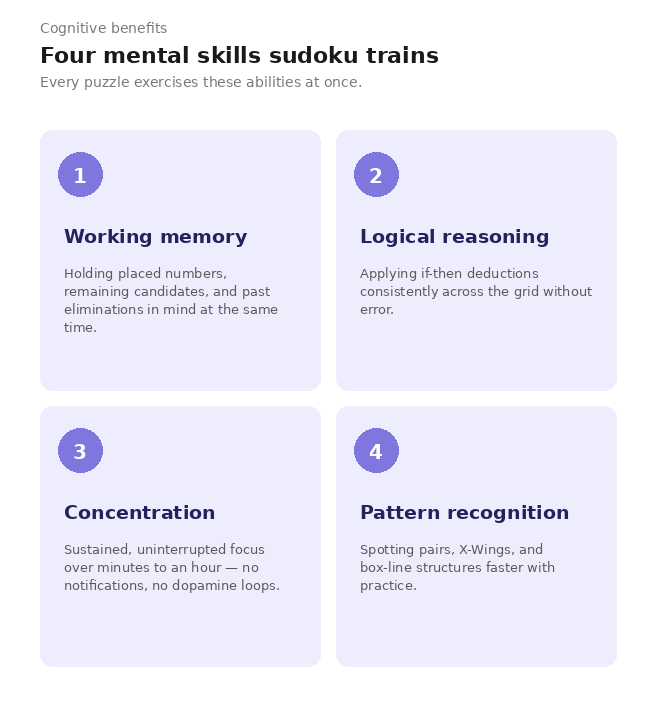
Working memory. You need to remember which numbers are placed, which candidates are still possible, and what eliminations you have made — all at the same time. Harder puzzles demand more from working memory because more cells remain uncertain for longer.
Logical reasoning. Sudoku is pure deductive logic. Every move follows from the rules. You are constantly applying if-then reasoning: if this number goes here, then that cell cannot contain it, which means this other cell must. Building strong logical reasoning habits through practice has value that extends beyond the puzzle.
Concentration and attention. A hard sudoku puzzle requires sustained, unbroken focus. A single lapse in attention can lead to a missed candidate or an incorrect placement that derails the entire solve. Playing regularly builds the habit of focused attention.
Pattern recognition. Experienced solvers start to see patterns — naked pairs, X-Wing setups, box-line intersections — faster and more naturally over time. This kind of pattern recognition is a trained skill, not an innate one.
Does Sudoku Improve Memory?
Sudoku exercises working memory — the type of memory used for holding and manipulating information in the short term. Using your working memory regularly keeps it active, in the same way that physical exercise keeps muscles conditioned.
The honest caveat is that research on brain training games is mixed. Playing sudoku will make you better at sudoku. Whether that improvement transfers directly to other areas of life — like remembering where you put your keys — is less certain. One fNIRS study published in PubMed Central measured significantly increased prefrontal cortex activity during sudoku solving — showing that the puzzle does engage the brain regions responsible for working memory, attention, and decision-making, even if long-term transfer effects remain debated.
What is more clearly supported is that staying mentally active, which regular puzzle solving contributes to, is associated with better cognitive maintenance over time. Sudoku is a good form of mental activity. It is not a magic solution, but it is genuinely useful.
Does Sudoku Help with Concentration?
This is probably where sudoku’s benefits are most clear. A medium or hard puzzle requires you to maintain focus for anywhere from 10 minutes to an hour. There are no notifications, no rewards for clicking, no algorithm serving you dopamine. It is just you, the grid, and the problem.
Regular practice with this kind of focused, uninterrupted attention — what some researchers call deep focus — is increasingly valuable in a world full of distractions. Many regular sudoku players report that their ability to concentrate on other tasks improves over time. The mechanism makes intuitive sense: you are repeatedly practising the act of sustained attention.
Who Benefits Most?
Sudoku is beneficial across a wide range of ages and skill levels, but the benefits look slightly different depending on who is playing.
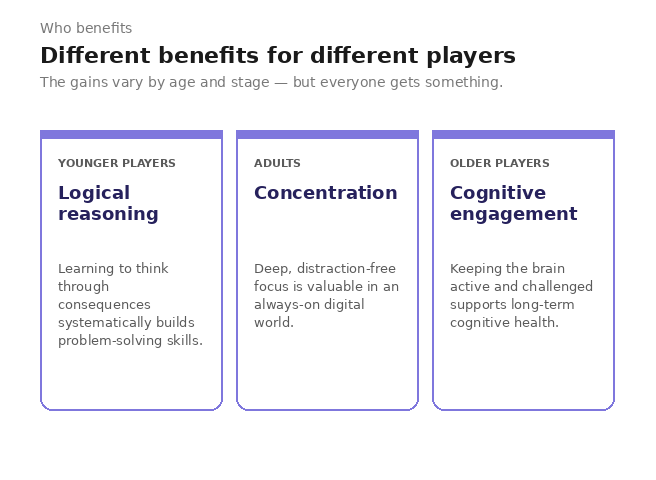
Beginners and younger players benefit most from the logical reasoning practice. Learning to apply rules systematically and think through consequences is a skill that transfers to problem-solving in other contexts.
Older players benefit most from the cognitive engagement aspect. Keeping the brain active and challenged is associated with better cognitive health as we age. Sudoku is accessible, scalable in difficulty, and can be played anywhere — making it a practical daily activity.
Players of all ages benefit from the concentration practice. Deliberately spending time in focused, distraction-free problem-solving is useful regardless of age.
How Often Should You Play?
Even 15 to 20 minutes of sudoku per day is enough to get real benefit. The key is consistency rather than marathon sessions. Daily practice builds the habits and patterns that make the cognitive benefits stick.
The daily puzzle format works well for this — one puzzle per day at a fixed difficulty gives you a regular, manageable mental workout without becoming a time sink.
The Best Way to Start
If you are new to sudoku, start with easy difficulty. Easy puzzles have more starting numbers, which means the logic is clearer and the solve is more straightforward. Build your confidence and understanding of the rules before moving to medium.
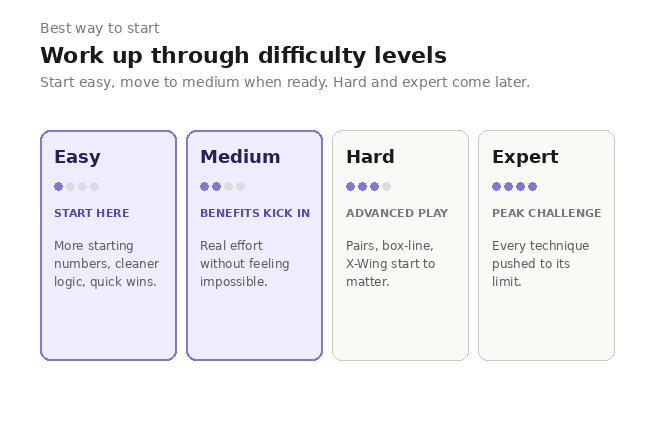
Once easy puzzles feel comfortable, move to medium. Medium difficulty is where most of the cognitive benefits kick in — the puzzles are challenging enough to require real effort and concentration, but approachable enough to finish in a reasonable time.
Play a free easy sudoku puzzle to start, or try the daily sudoku puzzle for a consistent daily habit. If you want to understand the game before playing, read the how to play guide.