How to Solve Sudoku Faster: Tips to Improve Your Speed
Whether you are trying to beat your personal best, compete on a leaderboard, or simply finish your daily puzzle before your coffee goes cold, solving sudoku faster is a learnable skill. Speed comes from two things: reducing the time spent on each move, and reducing the number of moves you need to make. This guide covers both.
Why Speed Matters Less Than You Think — At First
Before diving into speed tips, it is worth saying clearly: speed is a byproduct of skill, not a goal in itself. Solvers who try to go fast before they are accurate end up making more errors, which cost far more time to fix than they saved by rushing.
The fastest route to faster solving is first becoming a more accurate, more systematic solver. Once your technique is solid, speed follows naturally. Keep this in mind as you work through the tips below — focus on doing each step correctly, and the speed will come with repetition.
Tip 1: Always Sweep for Naked Singles First
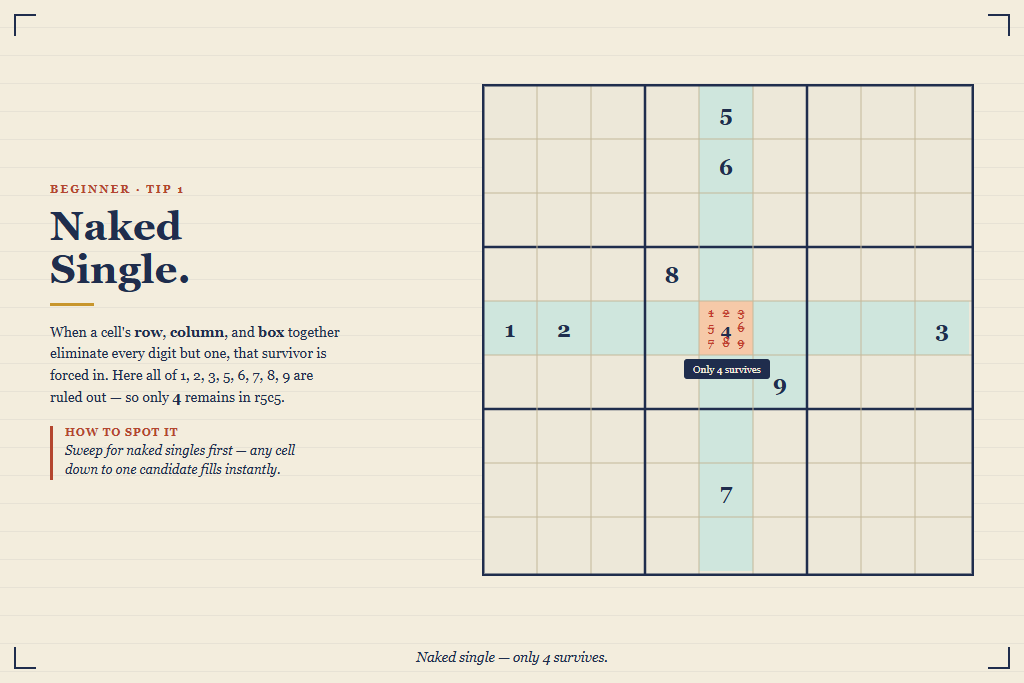
The fastest move in sudoku is a naked single — a cell with only one candidate remaining. Before doing anything else, scan the entire grid for cells with only one possibility. Fill them all in.
Then sweep again. Placing one naked single often creates another. Keep sweeping until no more naked singles are available. This takes seconds per pass and makes more progress faster than any other technique.
Experienced solvers develop an eye for naked singles that allows them to spot them almost instantly. This comes from repetition — the more puzzles you solve, the faster your eye finds the easiest placements.
Tip 2: Scan by Number, Not by Cell
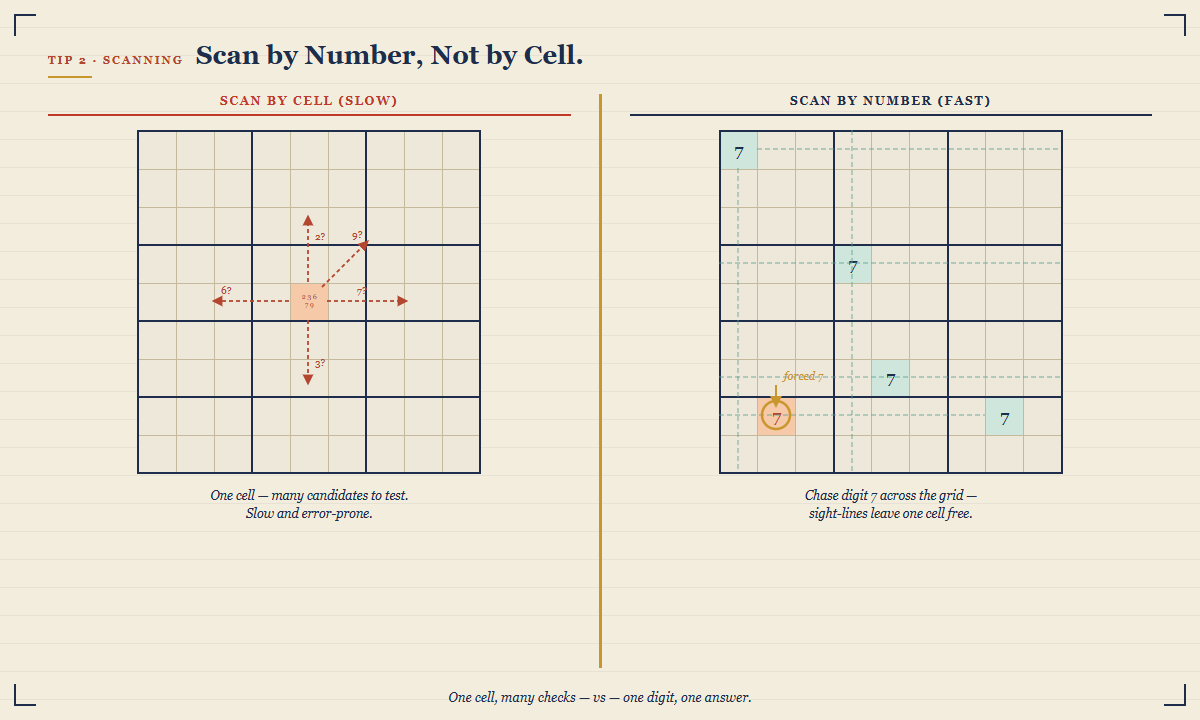
Many beginners scan by cell — looking at each empty cell and asking “what can go here?” Faster solvers scan by number — picking a number and asking “where can this go in each row, column, and box?”
Scanning by number is faster because it focuses your attention. When you scan for where 7 can go in the top-right box, you look at only the relevant cells rather than evaluating every candidate for every cell. You find placements faster and miss fewer hidden singles.
Work through numbers 1-9 systematically. For each number, scan each box and note where it still needs to be placed. Any box where the number can only go in one cell is an immediate placement.
Tip 3: Use Candidate Tracking Efficiently
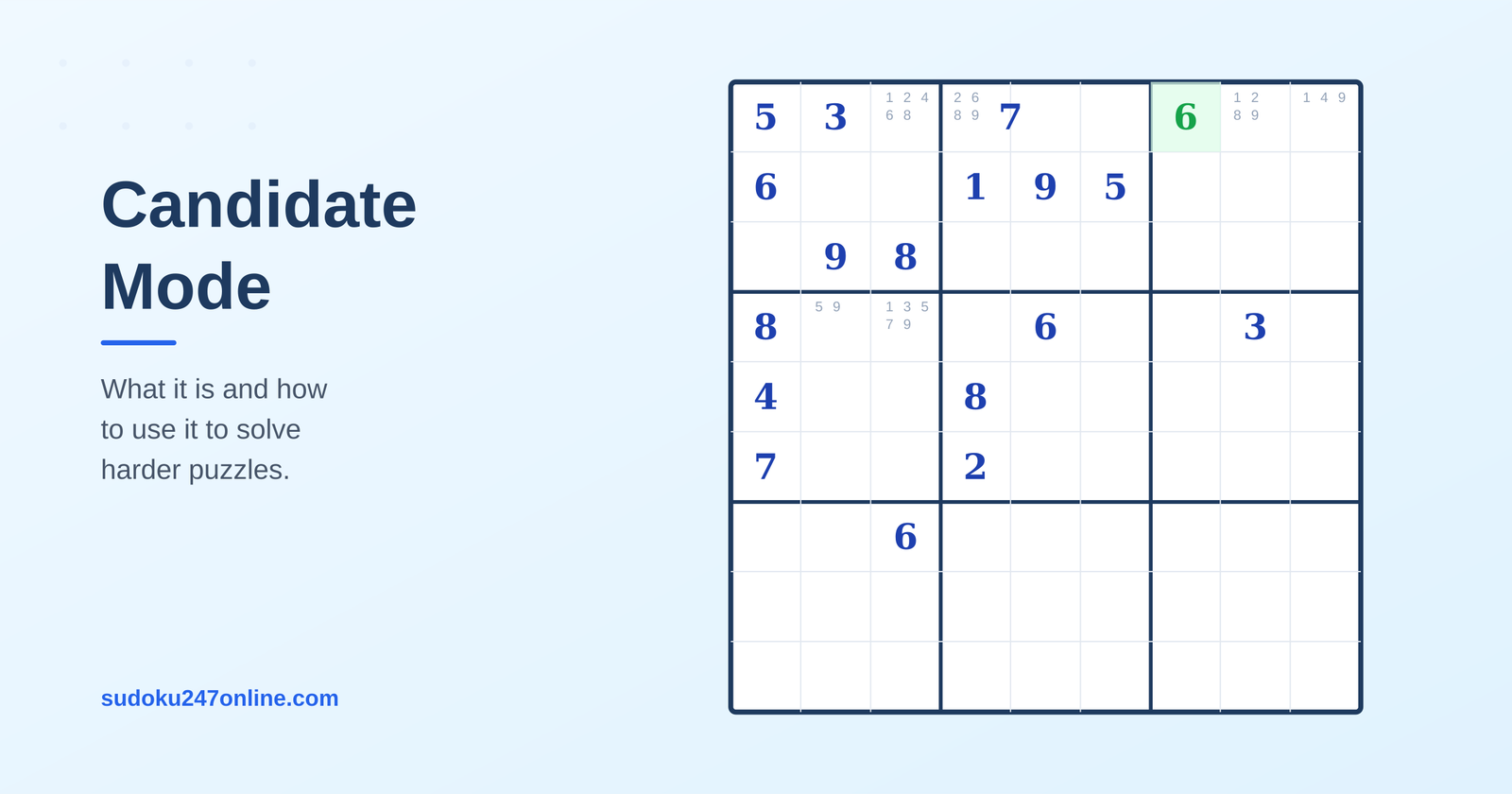
For hard puzzles, candidate tracking is essential — but how you track candidates affects your speed significantly.
Fill candidates in order. When doing the initial candidate fill, go cell by cell, row by row, rather than jumping around. Systematic coverage means you never miss a cell.
Update immediately. Every time you place a number, immediately eliminate it from candidates in the same row, column, and box. Do not defer updates — stale candidates slow you down and cause errors.
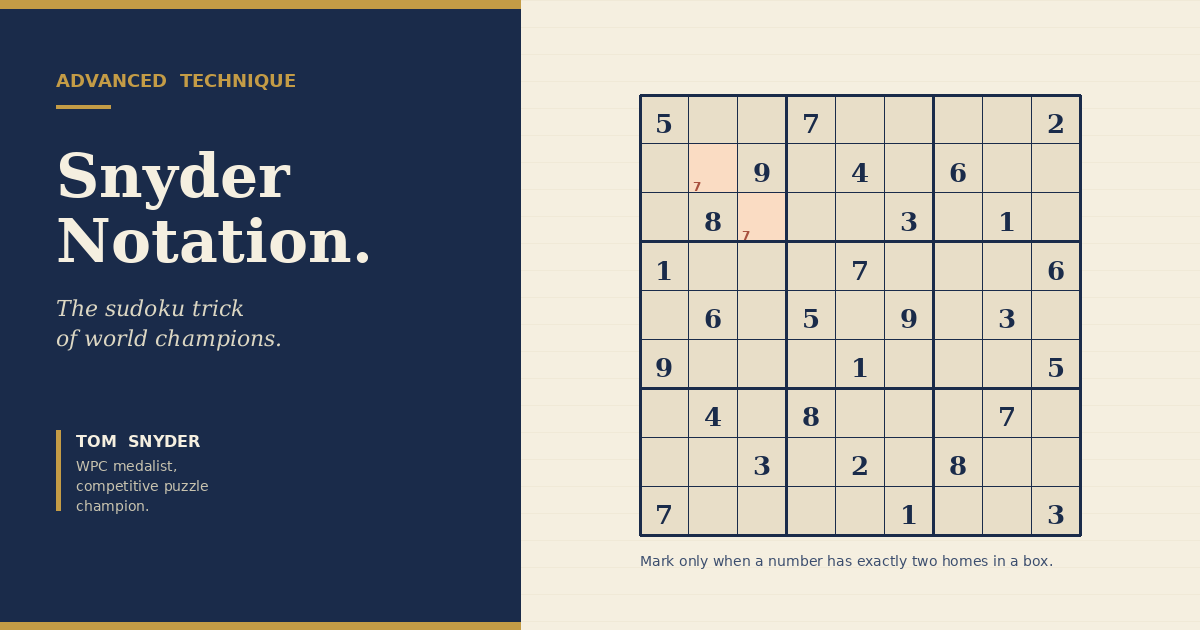
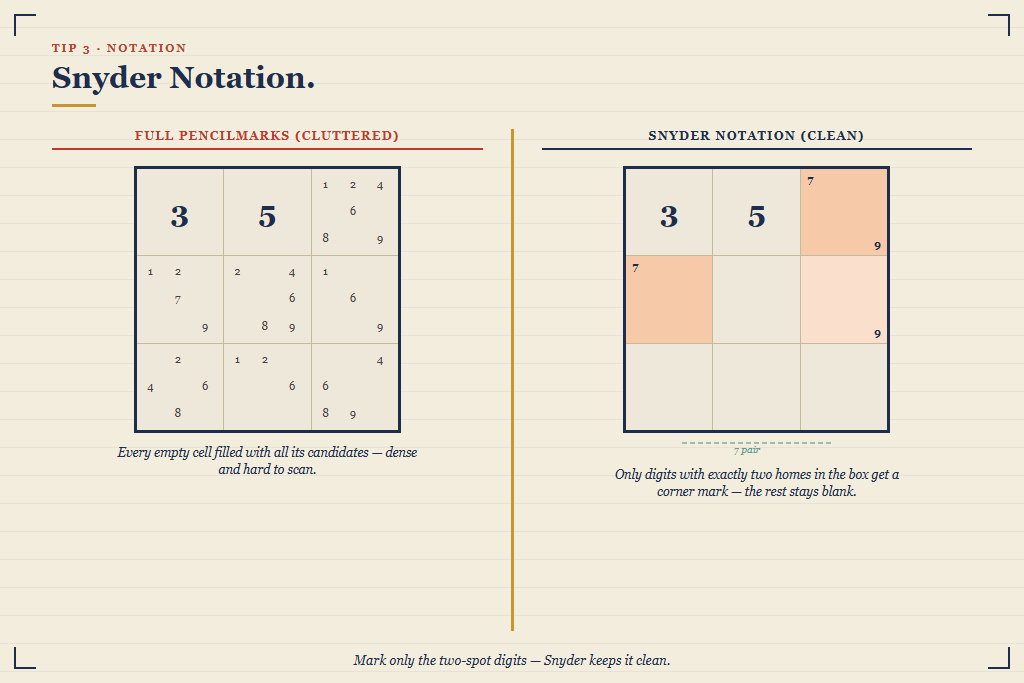
Use Snyder notation first. Rather than filling all candidates for every cell, start with Snyder notation — marking only cells where a number has exactly two possible positions in a box. This faster initial pass often reveals several placements before full candidate marking is needed.
Tip 4: Work on the Most Constrained Areas
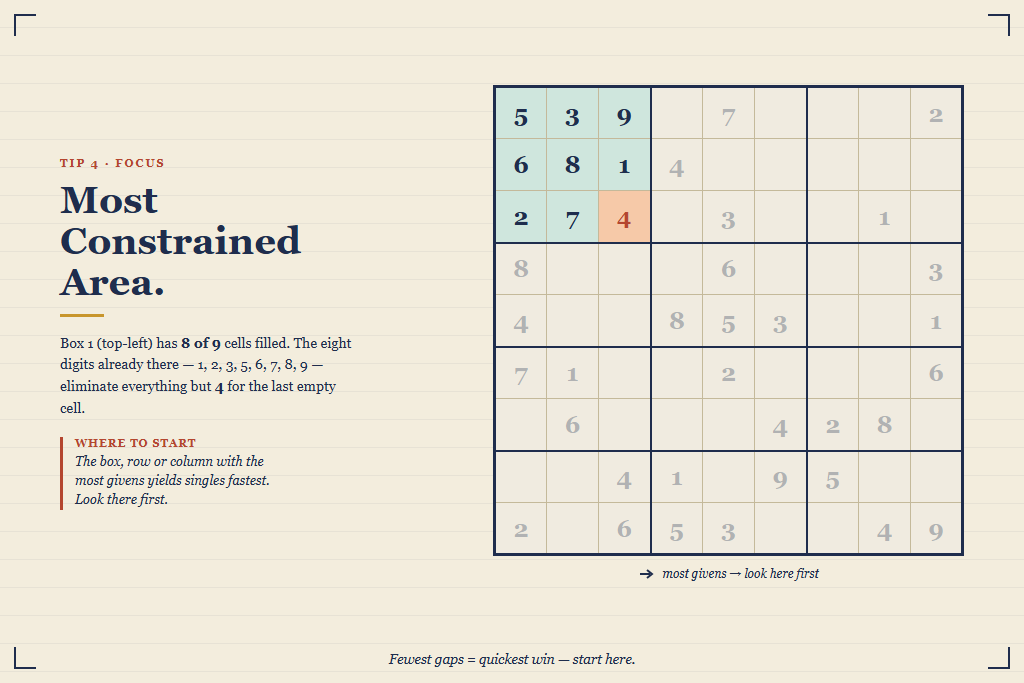
Not all areas of the grid are equally solvable at any given moment. The most constrained areas — rows, columns, or boxes with the most numbers already placed — offer the most information and therefore the most opportunities for deductions.
At the start of a puzzle, identify the three or four rows, columns, and boxes with the most givens. Work on these first. The deductions you make in constrained areas often cascade into less constrained areas, opening up the whole grid faster than working randomly.
Tip 5: Learn to Recognise Common Patterns Instantly
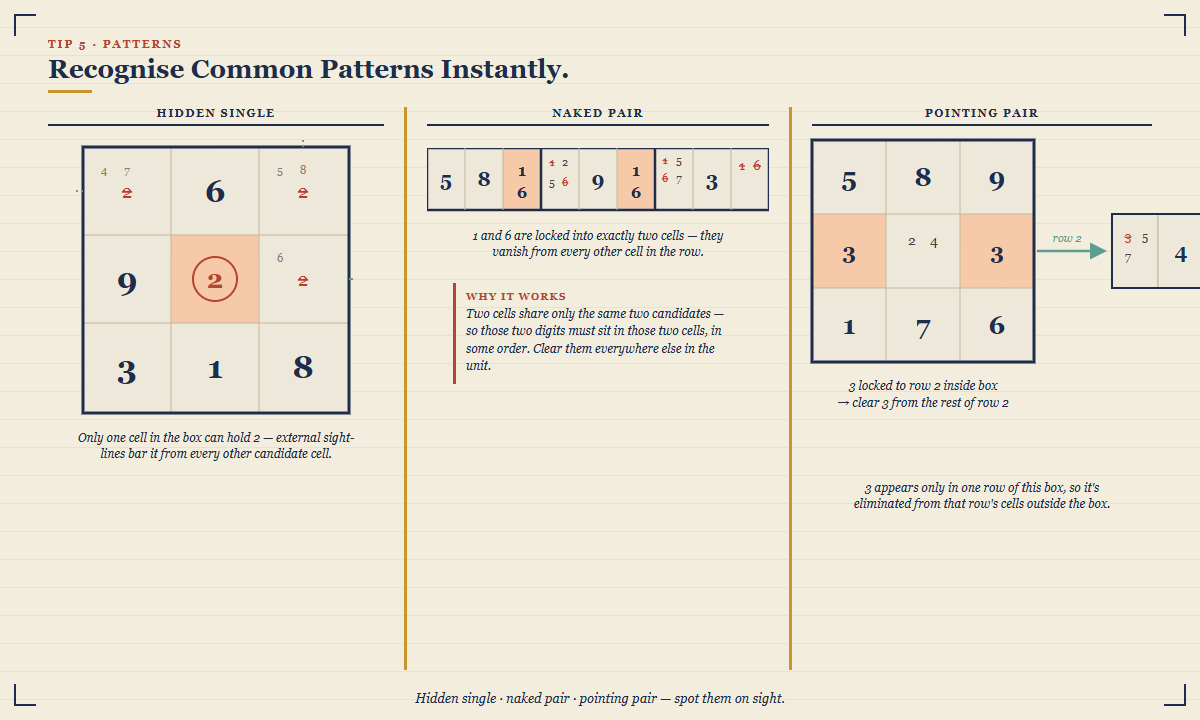
Speed in sudoku comes from pattern recognition — seeing a naked pair, a hidden single, or a pointing pair immediately rather than having to work through the logic slowly each time.
The patterns you need to recognise instantly for fast solving are:
Hidden singles. A number appearing in only one cell within a unit. Train yourself to spot this without counting — experienced solvers see it in a fraction of a second.
Naked pairs. Two cells in the same unit with identical candidates. With practice, these become visually obvious.
Pointing pairs. Two cells in the same box and same row or column with the same candidate. Once familiar, these are fast to spot during a systematic scan.
The way to develop instant pattern recognition is volume — solving a lot of puzzles. Aim for at least one medium or hard puzzle per day. Over weeks and months, the patterns become automatic.
Tip 6: Reduce Backtracking
Every time you make an error and have to undo moves, you lose time — sometimes a lot of it. Reducing errors is one of the most impactful things you can do for your speed.
Common causes of errors in sudoku:
Stale candidates. A candidate that should have been removed but was not. Always update candidates immediately after each placement.
Misreading the grid. Confusing which row or column a cell belongs to, especially in the middle of the grid. Slow down on any placement you are not fully confident about.
Rushing naked singles. The most common error — placing a number in a cell based on an incomplete scan, missing a constraint. Always check row, column, AND box before placing.
A clean solve with no backtracking is almost always faster than a faster-paced solve with two or three errors.
Tip 7: Time Yourself and Track Progress
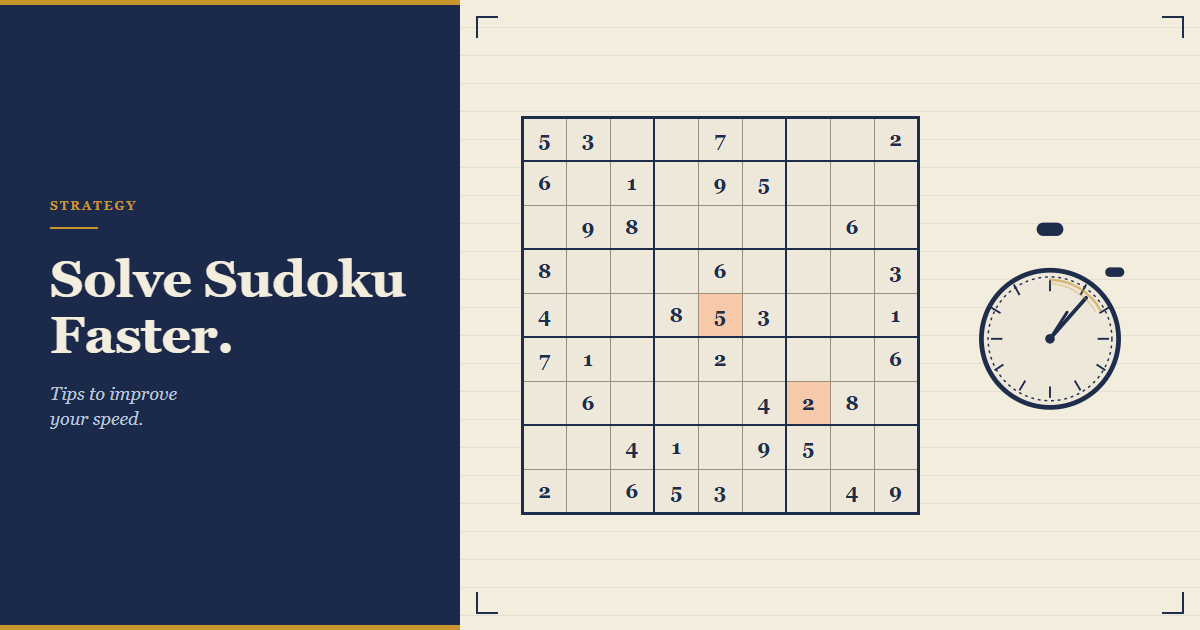
You cannot improve what you do not measure. Use the timer on the puzzle to track your solve times. Record your best times for each difficulty level.
Then look at where time is being lost. Are you spending a long time on the initial candidate fill? Work on doing it more systematically. Are you getting stuck for minutes at a time on hard puzzles? Learn the next technique that unlocks that type of puzzle.
Deliberate practice — identifying the specific weak point and working on it — improves speed far faster than simply solving more puzzles without reflection.
Realistic Speed Benchmarks
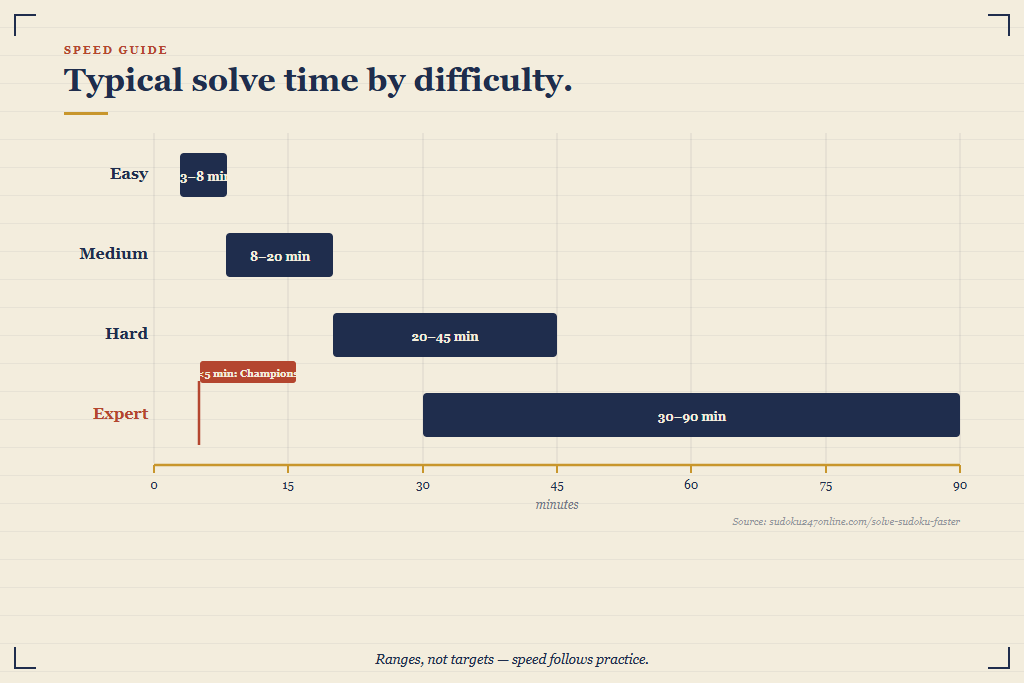
For context, here are approximate solve times for skilled recreational solvers on standard 9×9 puzzles:
- Easy: 3-8 minutes
- Medium: 8-20 minutes
- Hard: 20-45 minutes
- Expert: 30-90 minutes
Competitive solvers at championship level complete expert puzzles in under 5 minutes, but these are exceptional performers who have practised for years. For most recreational players, cutting their current time by 20-30% over a few months of consistent practice is a realistic goal.
The World Sudoku Championship publishes competition results if you want to see what elite-level solving looks like.
Try a timed hard sudoku puzzle and focus on applying these techniques from the start. Use the timer to track your progress over your next ten solves. For the specific techniques that unlock hard puzzles faster, read the advanced sudoku tips guide. For all techniques from beginner to advanced, browse the sudoku strategies guide.