Snyder Notation: The Sudoku Trick of World Champions

Most sudoku players who use candidate tracking write all possible numbers into every empty cell — a comprehensive approach that gives you complete information but can make the grid look cluttered and overwhelming. Snyder notation is a different approach: write fewer candidates, only in specific circumstances, and use that restraint to make patterns more visible. This guide explains what Snyder notation is, how it works, and when to use it.
What Is Snyder Notation?
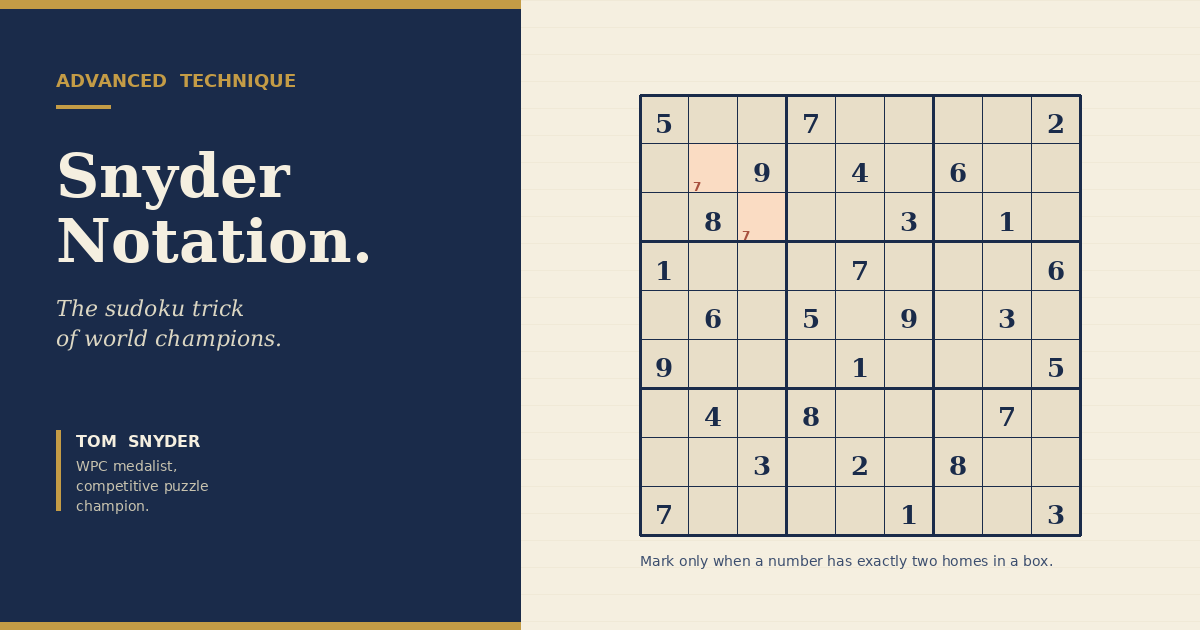
Snyder notation is a candidate-marking system developed by Tom Snyder, one of the most accomplished competitive puzzle solvers in the world and a multiple World Puzzle Championship medallist. Rather than filling in all candidates for every cell, Snyder notation instructs you to only mark candidates when a number has exactly two possible positions within a 3×3 box.
The idea is selective marking. Instead of recording every possibility everywhere, you record only the most constrained and therefore most useful information. This keeps your grid clean, reduces cognitive load, and makes certain patterns significantly easier to spot.
How Snyder Notation Works
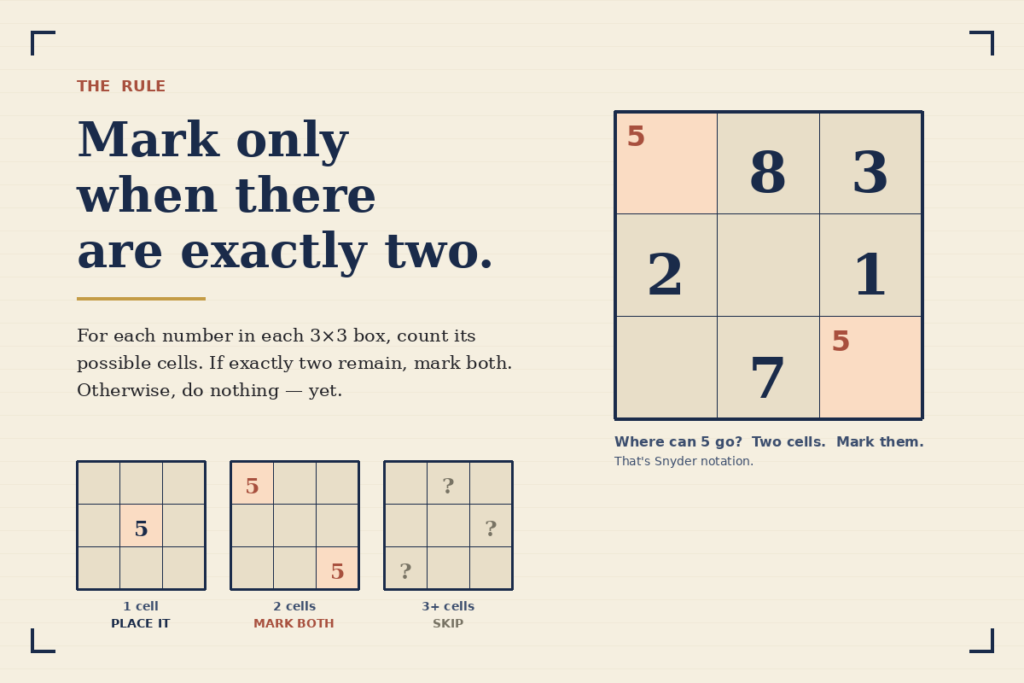
The rule is simple: for each number in each 3×3 box, if that number can only go in exactly two cells within that box, write the number as a small candidate in both of those cells.
If a number has three or more possible positions in a box, you do not mark it — there is not enough constraint yet to be useful. If a number has only one possible position in a box, that is a hidden single — place it immediately rather than marking it as a candidate.
Work through each box systematically, checking each unplaced number. For every number that has exactly two possible positions in the box, mark both cells.
Why Only Two Positions?
The power of the two-position constraint is that it creates a binary relationship. The number must go in one of exactly two cells in that box. This means that anything you can deduce about those two positions — through their rows, columns, or intersections with other boxes — has direct solving value.
When you mark candidates under Snyder notation and then scan the grid, you are looking at only the most highly constrained information. The patterns that emerge are cleaner and more actionable than what you see in a fully annotated grid.
Snyder Notation in Practice: Step by Step
Step 1. Choose a 3×3 box and pick a number that has not yet been placed in it.
Step 2. Look at the cells in that box that could contain the number. Eliminate any cell that shares a row or column with the same number already placed elsewhere in the grid.
Step 3. Count how many cells remain as possibilities for that number within the box.
Step 4. If exactly two cells remain, write the number as a small candidate in both cells. If one cell remains, place the number immediately. If three or more remain, move on — do not mark anything.
Step 5. Repeat for every unplaced number in every box.
Step 6. After marking, scan for patterns. Look for cells that have received the same two Snyder candidates — this can indicate a naked pair. Look for rows or columns where a Snyder candidate only appears in one box — this indicates a pointing pair elimination. Look for Snyder candidates that align across two boxes in the same rows, forming the basis of an X-Wing.
What Snyder Notation Reveals
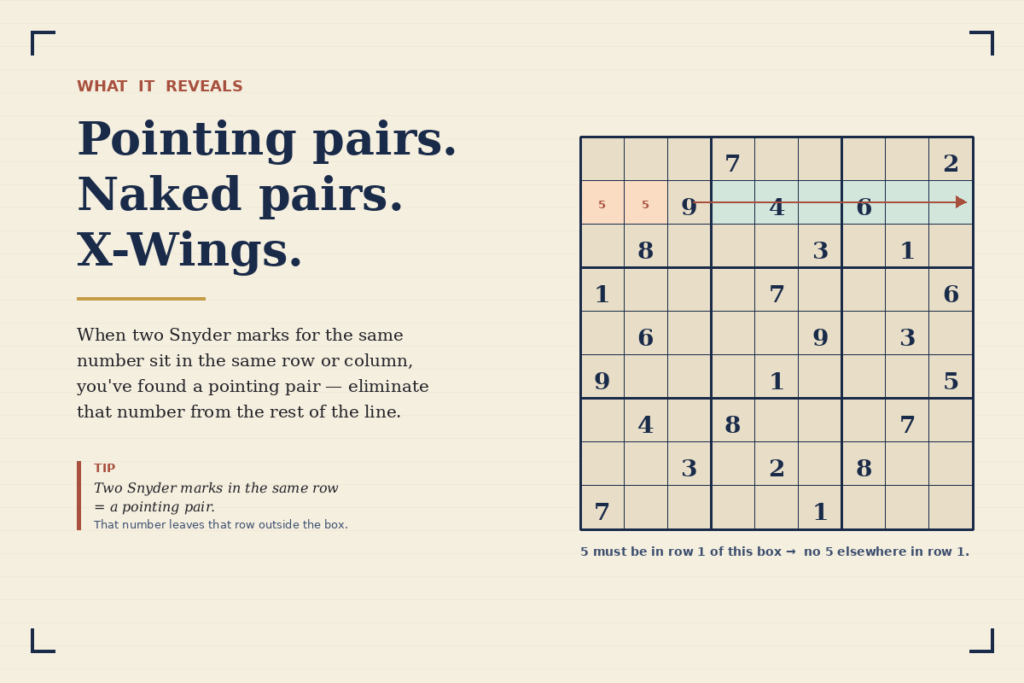
Because Snyder notation only marks highly constrained positions, the patterns it reveals tend to be directly actionable. Common discoveries include:
Pointing pairs. If both Snyder candidate marks for a number in a box fall in the same row or column, that number can be eliminated from the rest of that row or column outside the box.
Box-line reduction. The complement of pointing pairs — if a number’s only candidates in a row all fall within the same box, you can eliminate it from the rest of that box.
Hidden pairs and naked pairs. Two cells that share the same pair of Snyder candidates within a unit are often the basis of a pair elimination.
X-Wing setup. When Snyder candidates for the same number align across two rows in the same two columns, an X-Wing pattern may be present.
Snyder Notation vs Full Candidate Marking
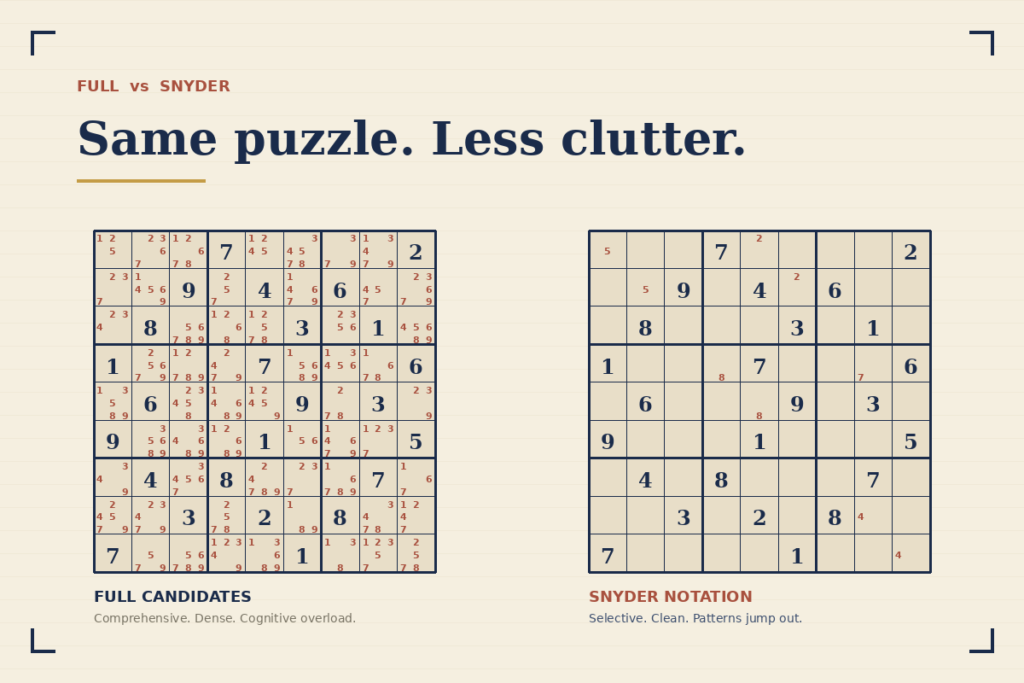
Neither approach is objectively better — they suit different solving styles and different puzzle difficulties.
Full candidate marking gives you complete information at all times. It is methodical, comprehensive, and leaves nothing to chance. The downside is that a fully annotated grid can be visually overwhelming, especially at the start of a hard puzzle when most cells have five or six candidates.
Snyder notation gives you selective, high-value information. It is faster to mark initially, keeps the grid visually clean, and highlights the most constrained positions. The downside is that it requires more pattern recognition skill to use effectively, and some solving techniques require full candidate information to apply.
Many experienced solvers use Snyder notation as an initial pass — marking the most constrained positions first to find quick wins — and then switch to full candidate marking if the puzzle requires deeper analysis.
Learning Snyder Notation
The best way to learn Snyder notation is to apply it to a hard puzzle you have not attempted before. Work through each box, mark only the two-position candidates, and then spend time looking at what the marks reveal before placing any numbers.
You may find that several placements become available immediately from the pointing pairs and box-line reductions that Snyder marking reveals. This fast initial progress — unlocked by selective rather than exhaustive candidate marking — is what makes the technique attractive to experienced solvers.
Tom Snyder has discussed his approach to solving in various puzzle competition contexts. His broader work in competitive puzzling can be explored at the World Puzzle Federation.
Try a hard sudoku puzzle and experiment with Snyder notation on your next solve. For more on the candidate tracking techniques that Snyder notation builds on, read about candidate mode. For the patterns Snyder notation helps reveal, see the guides on X-Wing and hidden pairs. Browse all techniques in the sudoku strategies guide.