What is the Hardest Sudoku Puzzle Ever Made?
If you have mastered expert-level sudoku and are looking for the ultimate challenge, you may have wondered whether there is a definitive hardest sudoku puzzle — one puzzle so difficult that it represents the absolute limit of what the format can produce. The answer is complicated, and depends on how you define “hard.” This guide explores the world’s most difficult sudoku puzzles, how difficulty is measured, and what separates a merely hard puzzle from a genuinely extreme one.
How Is Sudoku Difficulty Measured?
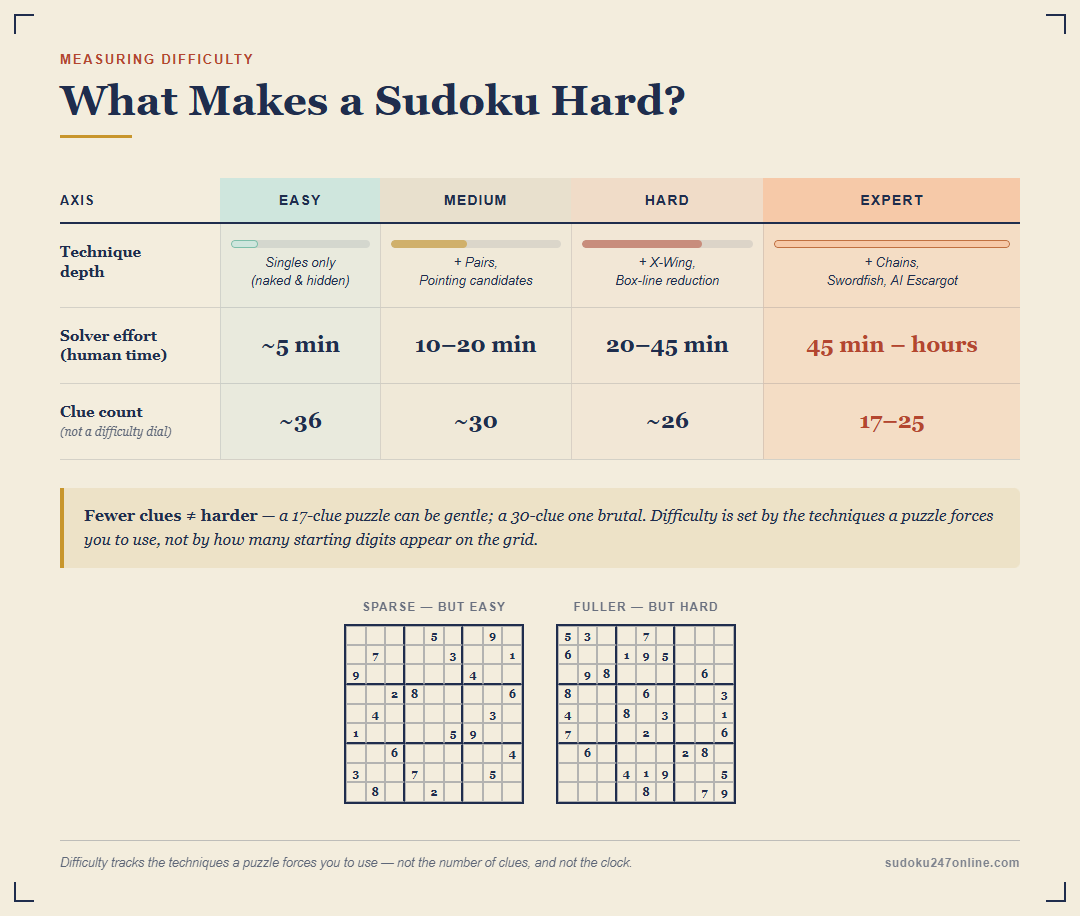
Before identifying the hardest puzzles, it is worth understanding how difficulty in sudoku is actually measured — because it is not simply about how long a puzzle takes to solve.
The most rigorous way to measure sudoku difficulty is by the minimum set of techniques required to solve it logically. Under this definition, a puzzle is harder if it requires more advanced techniques. A puzzle that needs only naked singles and hidden singles is easy. A puzzle that requires X-Wing is harder. A puzzle that requires chains, forcing chains, or Ariadne’s Thread — a controlled form of trial and error — is harder still.
Some researchers use computational difficulty — how long a computer algorithm takes to solve the puzzle using backtracking. Others use solver ratings based on the techniques required.
Different rating systems sometimes disagree on which puzzle is hardest, which is why there is no single universally agreed “hardest sudoku” — but there are puzzles that consistently appear at the top of every difficulty ranking.
AI Escargot: The Most Famous “Hardest” Puzzle
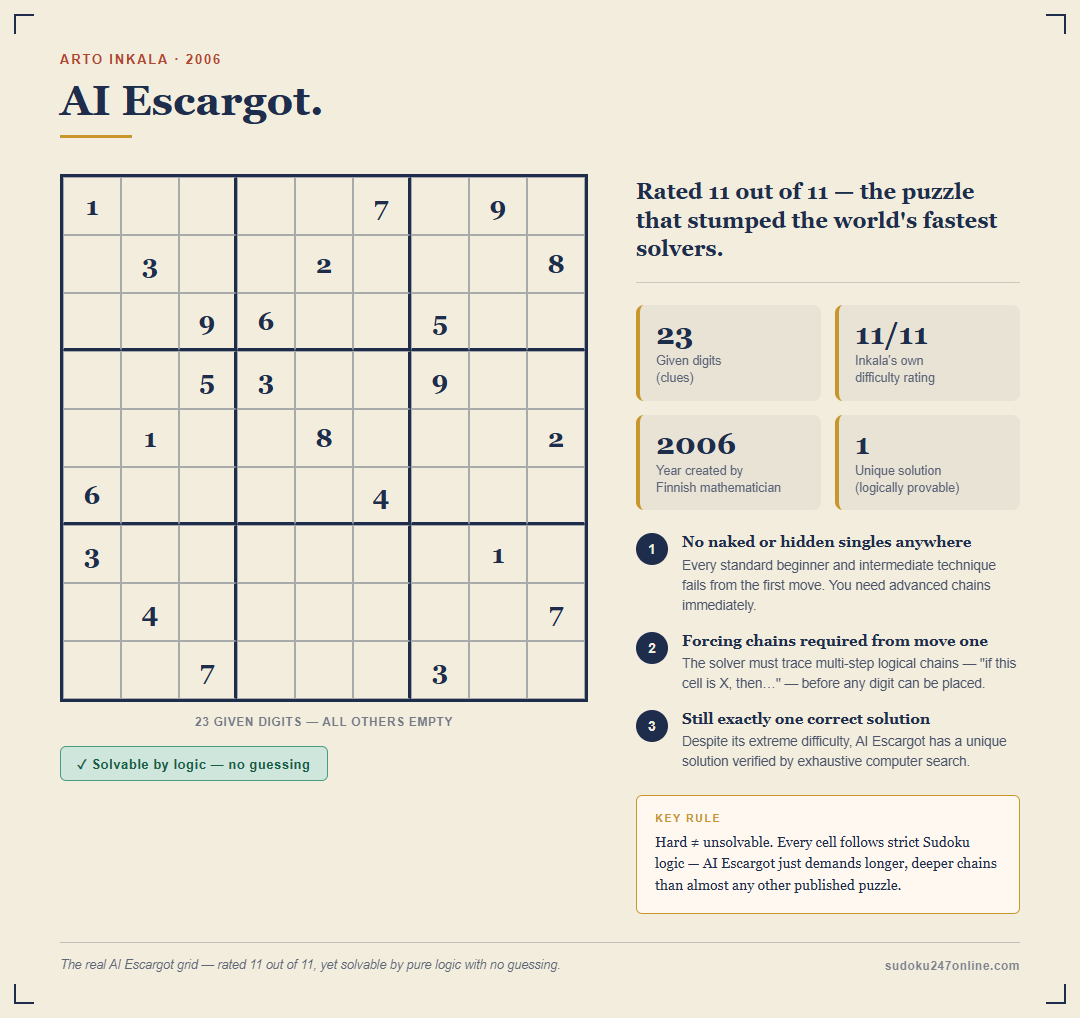
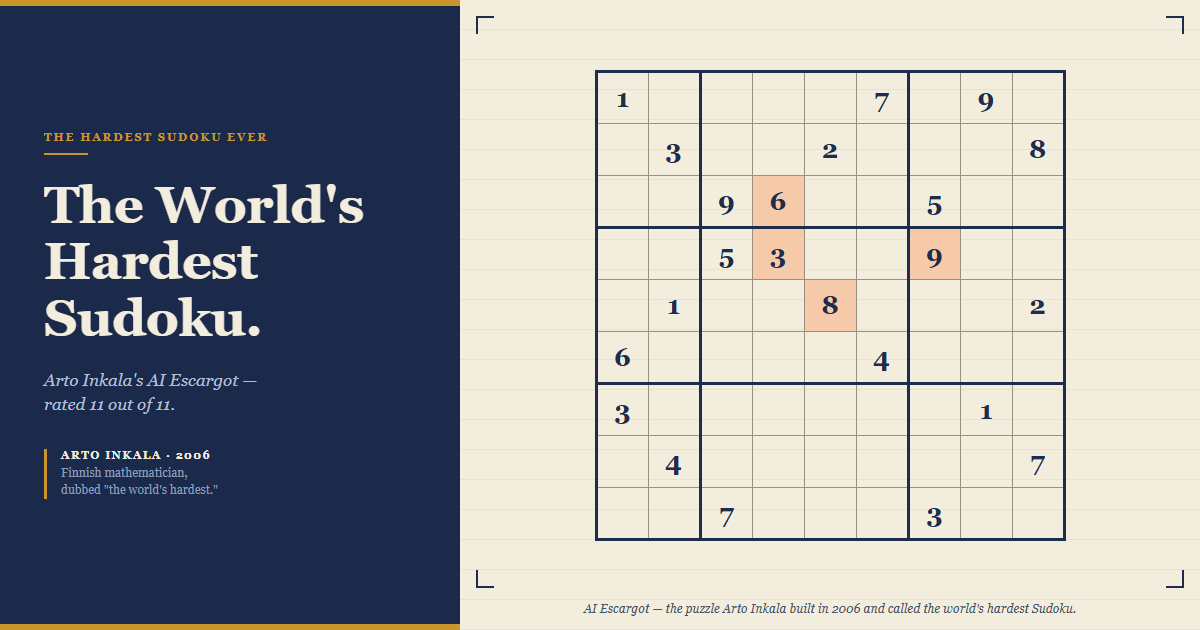
The puzzle most frequently cited as the hardest sudoku ever created is called “AI Escargot”, created by Finnish mathematician Arto Inkala in 2006. Inkala designed the puzzle specifically to be as difficult as possible for human solvers, rating it “11 out of 11 stars” on his own difficulty scale.
AI Escargot became famous when it was published in The Times and other newspapers as “the world’s hardest sudoku.” It requires extremely advanced techniques — most human solvers cannot complete it without some form of trial and error or forcing chains. Even experienced competitive solvers find it challenging.
Arto Inkala later created another puzzle in 2010 that he claimed was even harder than AI Escargot — but the difficulty claims for both puzzles are based on his own rating system rather than a universally accepted standard.
The “Hardest” Puzzle According to Computational Solvers
In 2012, researchers studying the mathematics of sudoku identified what they called the “hardest” sudoku puzzles from a computational perspective — puzzles that took the longest for backtracking algorithms to solve. These are not the same puzzles that are hardest for humans, because computers and humans use fundamentally different solving approaches.
The same research, published by mathematician Arto Inkala in collaboration with others, confirmed that puzzles with minimal givens (17 clues — the theoretical minimum for a valid sudoku) are not necessarily the hardest. Some 17-clue puzzles are relatively straightforward. The difficulty comes from the specific arrangement of numbers, not just their quantity.
Minimum Clues: The 17-Clue Puzzle
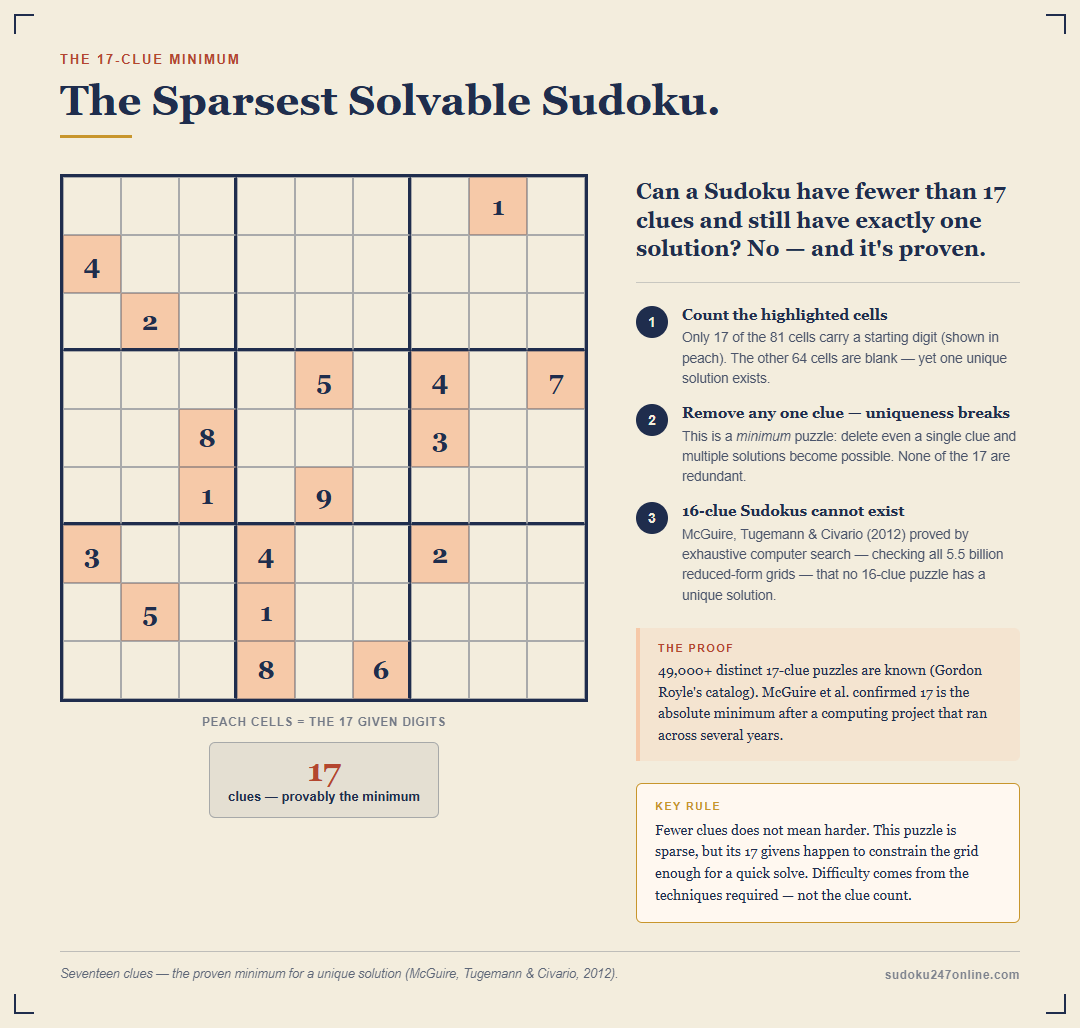
A separate dimension of sudoku difficulty involves the minimum number of given clues required for a puzzle to have a unique solution. In 2012, mathematicians Gary McGuire, Bastian Tugemann, and Gilles Civario proved computationally that 17 is the minimum number of clues for a valid sudoku puzzle. No valid sudoku puzzle with 16 or fewer clues exists.
Finding a 17-clue puzzle with a unique solution is itself a remarkable mathematical achievement. These puzzles are not necessarily the hardest to solve — some are relatively approachable — but their existence represents the theoretical boundary of the puzzle format.
The paper by McGuire, Tugemann, and Civario is available on arXiv.
What Makes Expert-Level Puzzles So Hard?
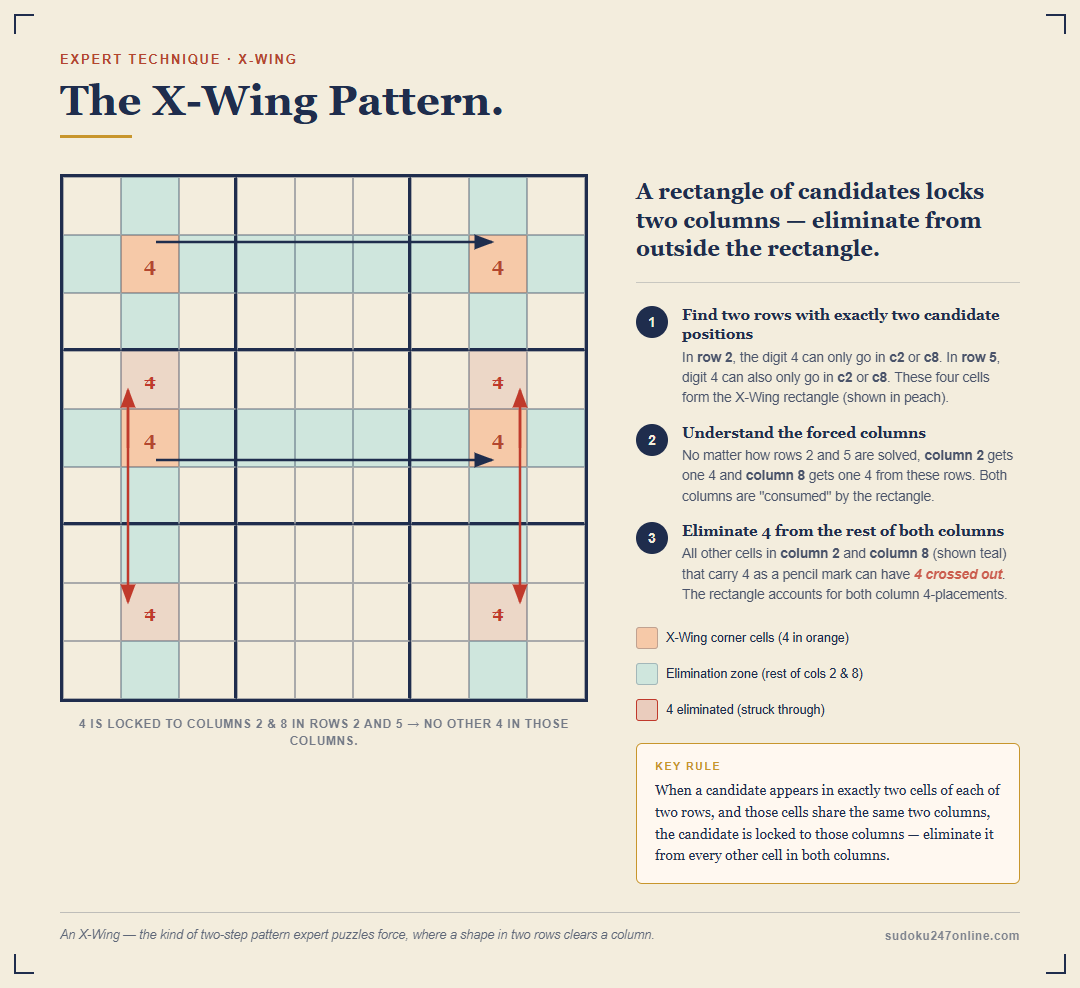
For practical purposes — puzzles you would actually encounter and try to solve — the hardest readily available puzzles are expert and “diabolical” level puzzles from reputable puzzle publishers. These consistently require:
Advanced pattern recognition. X-Wing, swordfish, XY-Wing, and W-Wing are the minimum toolkit for most diabolical puzzles.
Long chains. Techniques like Alternating Inference Chains (AIC) require tracing a logical path through dozens of cells — holding a long chain of if-then reasoning in mind simultaneously.
Uniqueness arguments. Techniques like the Unique Rectangle exploit the fact that a valid puzzle must have exactly one solution, using that constraint to make eliminations that could not otherwise be justified.
Forcing chains. Some puzzles — including AI Escargot — essentially require you to assume a candidate is true or false and follow the logical consequences, which is the closest approach to guessing that pure logic allows.
The Hardest Puzzles Are Still Logically Solvable
It is important to note that even the hardest sudoku puzzles ever created — including AI Escargot — are technically solvable by logic alone without random guessing. The techniques required are extremely advanced and the chains of reasoning are long and complex, but a path exists.
This is what makes these puzzles remarkable rather than merely frustrating. They represent the upper limit of what deductive logic applied to a 9×9 grid with three constraints can produce. Every step follows necessarily from the rules.
Try the Hardest Puzzles Available Online
If you want to test yourself against the most challenging puzzles available, expert difficulty on this site generates verified hard puzzles that require advanced techniques. If you can solve expert puzzles consistently, you have developed the skills needed to approach the world’s hardest published sudoku.
Build up your technique with the sudoku strategies guide — covering everything from hidden singles to X-Wing. For the specific techniques that the hardest puzzles require, start with X-Wing, hidden pairs, and candidate mode.